

My Fence Is Leaning and the Posts Are Rotting
The whole run leans toward the neighbour and the posts snap at the ground when you push them. Why posts fail in a Hamilton winter, and how we rebuild the failed section, or the whole fence, so it stays straight. Lumen Landscaping rebuilds failed fence sections and whole fences across Hamilton: call (905) 906-0671 or send the form for a free written quote.
- Fully insured
- 1-year craftsmanship warranty
- Hamilton owned and operated
Quick to quote, quick to start, we answer every call.
Serving Hamilton, Burlington, Oakville and the wider region, from Guelph to Niagara.
Get your fast, free quote
We reply fast, usually within the hour.
The problem
What you are seeing
The fence was straight for years. Then one spring a section leaned a few degrees toward the neighbour, and by fall the gate would not latch. You pushed on a post and it moved. You pushed harder and it snapped off at the ground, the top two thirds of it still perfectly sound. The boards are fine. The rails are fine. The fence is leaning because the part of each post that is in the ground has rotted, or because the posts were never set deep enough to stay put through a winter.
A fence has three parts: posts, rails and boards, and the posts are the only part that touches the ground, so they are the first to fail. The rails and boards on a leaning section are rarely far behind: the rail ends have sat wet against the post, and the fasteners have worked loose with every lean. That is why we do not swap single posts under old panels. We rebuild the run that has failed, with new posts set below the frost line and new rails and boards on them matched to the fence you have, and the sound part of the fence stays.
The honest line is that a fence whose boards have gone brittle and whose rails are rotted at the ends is a new fence, and we will say so when we see it. A fence with a few bad posts and solid panels elsewhere is a rebuild of that section, and we say that too.
Our Work
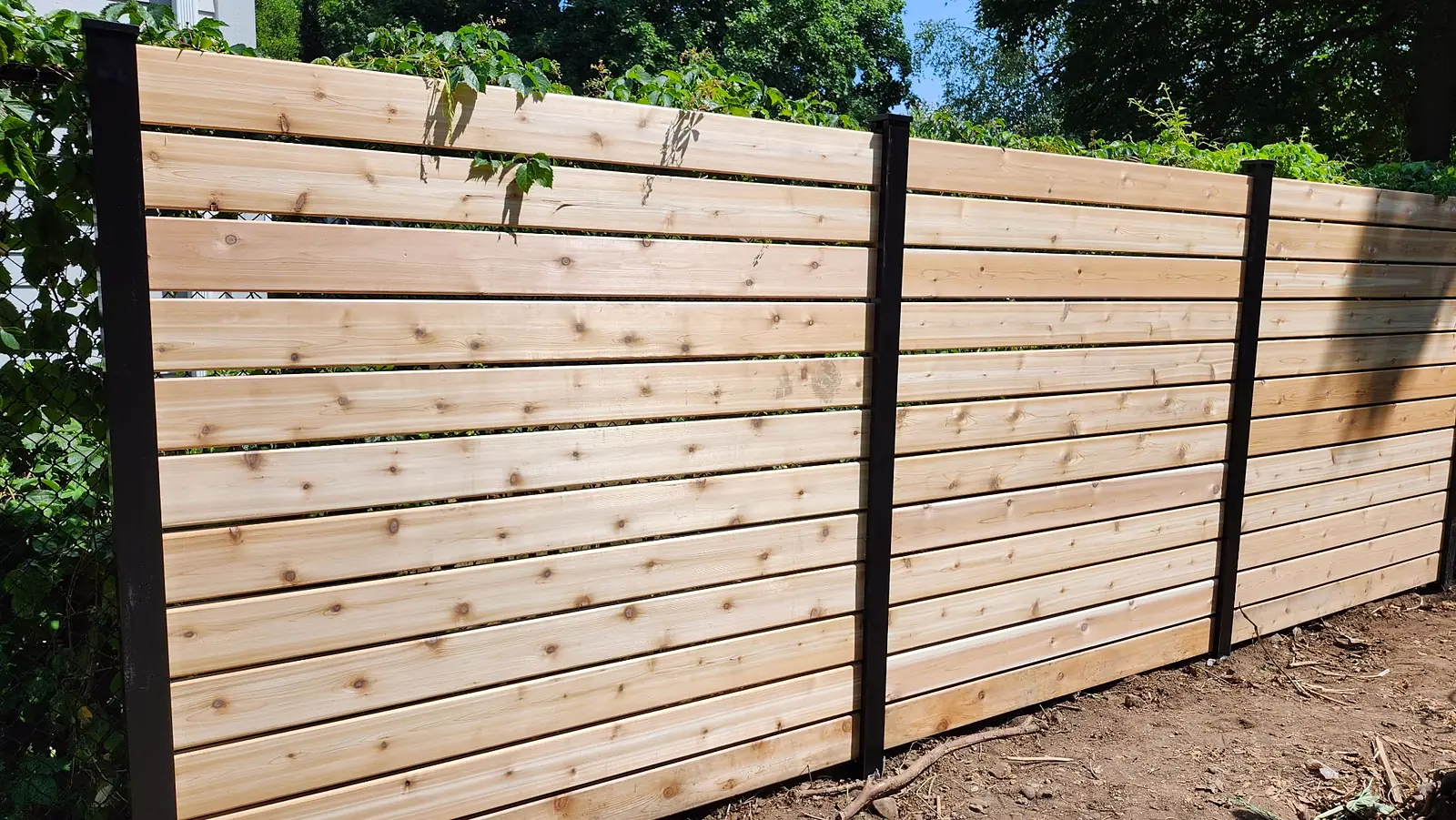
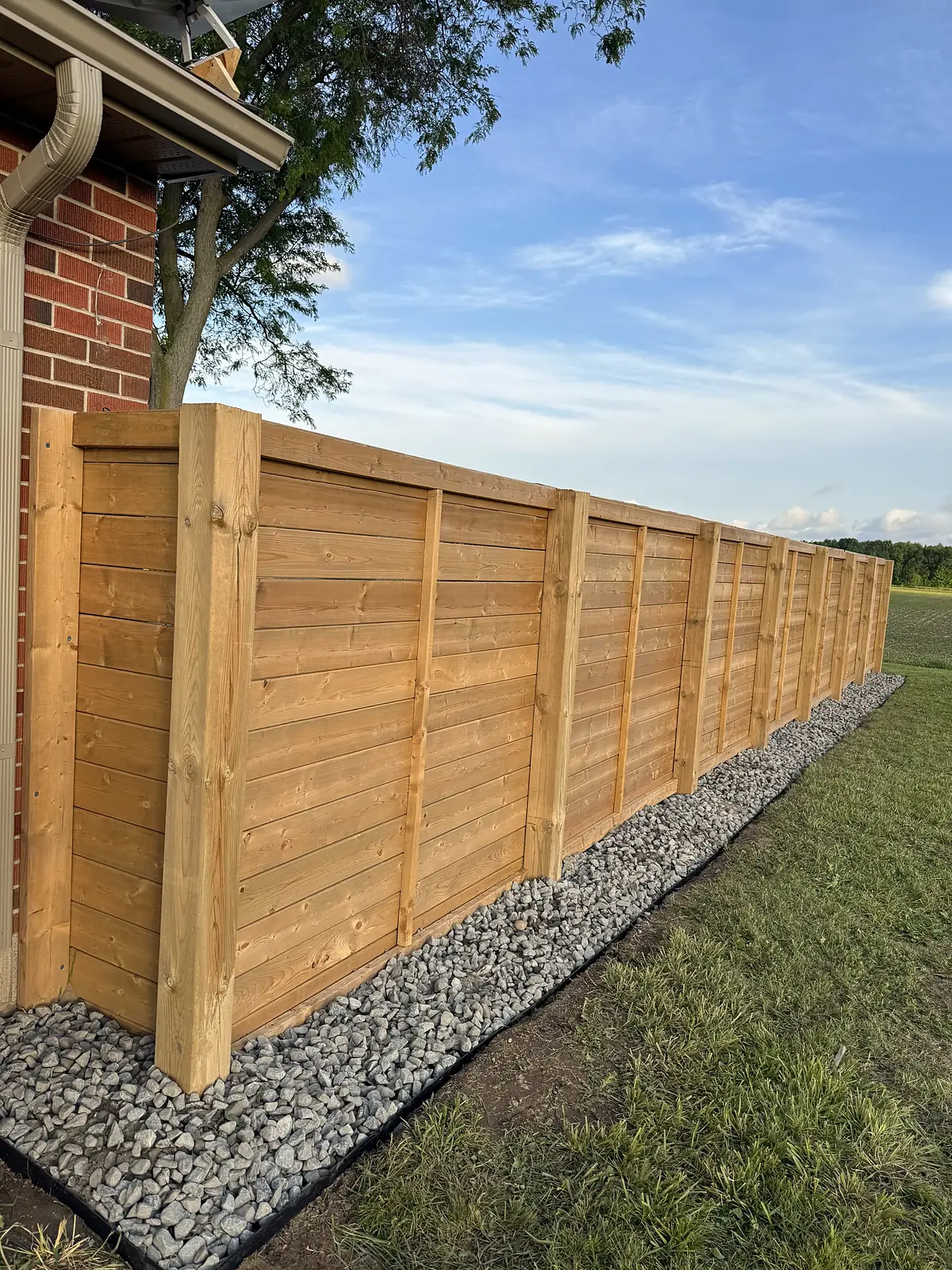
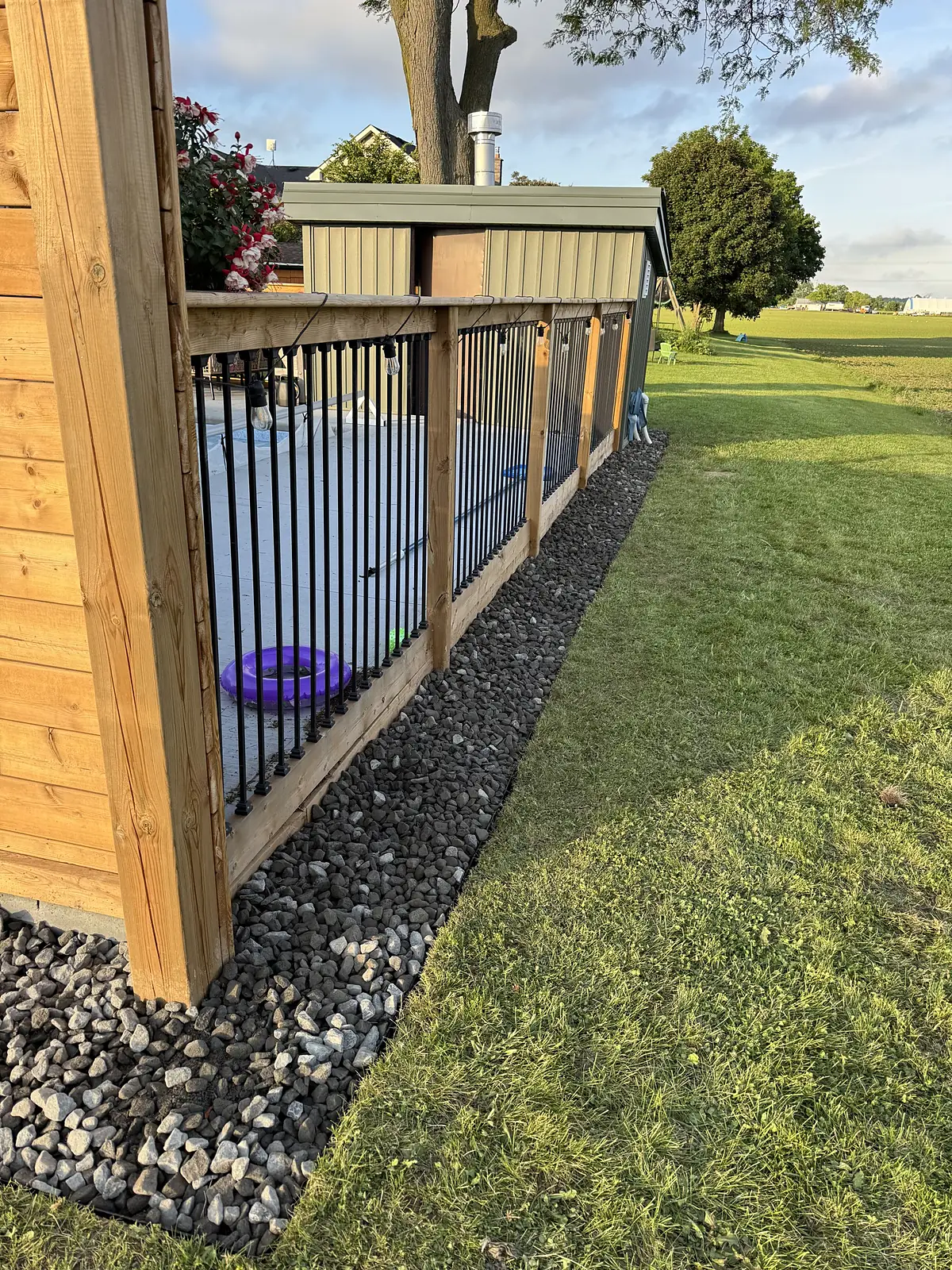
Fences, gates and privacy screens we have built

Why posts rot and fences lean
Posts fail in the first foot above and below the ground, and almost always for one of these reasons.
- Rot at the ground line: Wood rots where it is wet and gets air, which is the band right at the soil surface. A post can be solid above and solid below and rotted through in that band, which is why it snaps there.
- Set in soil, or too shallow: A post set in a shallow hole with the dirt pushed back around it has nothing holding it. The first solid privacy fence it carries, in the first strong wind, starts the lean.
- Frost heave: Frost in the Hamilton area reaches about 1.2 m down, the depth Ontario building standards use for foundations here. A post or a concrete collar that stops above that gets gripped by frozen ground and lifted a little every winter, and never quite settles back.
- A concrete collar that holds water: Concrete poured around a post with the top dished toward the wood collects water right where the post is most likely to rot. The concrete that was supposed to protect it finishes it off.
- Clay: On the clay plain in Binbrook, Glanbrook and Mount Hope, the ground swells when wet and heaves hard when frozen. Posts there need to go deep and sit on gravel that drains, or they move every year.
- Load the posts were not set for: A gate post carries the whole weight of a swinging gate. A solid privacy panel catches wind like a sail. Posts set for a low picket fence give up under either.
Google reviews
What our customers say
“We greatly appreciate Dan's attention to detail. Our deck also feels incredible sturdy. He is clearly a skilled carpenter and we have gotten many compliments on our backyard.”
“Thank you for helping my mother with the fence and patio, everything turned out beautifully.”
“Lumen Landscaping built our new beautiful fence on time and well within our budget. … If you are looking for a new fence, I highly recommend Lumen Landscaping for the job!”
The fix
How we rebuild the failed section
We take down the panels on the failed run and mark the line. The old posts come out with whatever concrete is around them, and each hole is dug deeper than it was, below the frost line, with gravel at the bottom so the post is not standing in water. New posts go in plumb and in line with the sound part of the fence, set solid, and new rails and boards go on them in the same style and height as the rest, so the rebuilt section reads as one fence. A gate post gets set with the gate's weight in mind, and the gate is re-hung so it swings and latches. We do not replace single posts under the old panels: a post swap leaves rotted rail ends and loose boards hanging on a new post, and the lean is back in a few years. That is the repair side of our fences and gates service.
When the boards have gone brittle, the rails are rotted at the ends or most of the posts have failed, we tell you that a new fence is the better value and quote it: privacy fences, horizontal cedar, gates that stay square, built by the same crew as our decks and fences. If what you really want is more height for privacy, our page on no privacy in the backyard explains what the by-laws allow and what to do above the fence line.
Two things happen before any post hole is dug. Ontario One Call gets a locate request, because by law anyone digging in Ontario must have one, it is free, and it takes about five business days. And the height stays within the rules: in Hamilton, Fence By-law 10-142 allows a fence up to 2.0 m on a residential lot and 0.9 m inside a corner or driveway visibility triangle. A fence on the line is shared, and if the lean has been sending water or soil onto the neighbour's side, our page on runoff from the neighbour's yard covers that conversation too.

Check this yourself first
Twenty minutes along the fence line will tell you whether this is one section to rebuild or the whole fence.
- Push every post: Lean on each post at shoulder height. A post that moves at the base has failed. Count them. A few failed posts together in a sound fence means that section gets rebuilt. Most of them, plus rotted rails, means a new fence.
- Look at the ground line: Scrape the soil back from a leaning post and press a screwdriver into the wood just below grade. Soft, dark wood that the screwdriver sinks into is rot.
- Check the rails and boards: Press the screwdriver into the rail ends where they meet the posts, and into a few boards near the bottom. Sound wood there means the rest of the fence stays. Spongy wood means the panels are on their way too.
- Watch the gate: A gate that drags or will not latch is usually the gate post moving, not the gate. That post carries more than any other and is often the first to go.
- Know whose fence it is: A fence on the property line is shared with the neighbour. Have that conversation before the quote, so nobody is surprised by a crew in the side yard.
- When to call: A lean that is getting worse, a post that moves at the base, or a gate that no longer latches is worth fixing this season, before the panels start to pull apart. Call (905) 906-0671 and we will take a look.

Planning
What a lasting repair includes, and what changes the price
A lasting fix always includes
- A locate from Ontario One Call before any hole is dug
- The old posts and their concrete out, not cut off at the ground
- Holes dug below the frost line, with gravel at the bottom so the posts drain
- New posts set plumb, in line, and solid
- New rails and boards on the rebuilt section, matched to the rest of the fence
- Gate posts set for the gate’s weight and the gate re-hung to latch
What affects the price
- How long the failed section is, and how many posts are in it
- Whether the old posts are in concrete that has to be broken out
- Matching the style and height of the fence that stays
- Gate posts and gates, which take more setting than a line post
- Access to the fence line: a side yard, or a backyard reached through the neighbour’s
- Ground that is clay or full of roots and stone
A typical job, in plain words. Picture a side yard privacy fence with three posts that move and a gate that drags, in a run of ten. We take down that end of the fence, pull the three posts and their collars, dig below frost, set new posts with new rails and boards in the same style, and re-set the gate post so the gate swings clean. The rest of the fence stays, and the rebuilt section is straight for good. On a newer street in Waterdown or on Stoney Creek Mountain, the same job often comes up a few years after the builder’s fence went in, because those posts were set fast and shallow. On the clay in Binbrook the holes go deep and get gravel at the bottom, or the posts are back out of line in two winters.
Every quote is written and free, and materials are billed at what they cost us with no markup.
Related
Related pages
Services: fences and gates and decks and fences. Related problems: no privacy in the backyard and runoff from the neighbour's yard. Areas: Hamilton and Binbrook and Glanbrook. More answers on our FAQ page, and more problems we fix.
FAQs
Leaning fence questions
No, and we say so up front. A new post under old panels leaves rotted rail ends and loose boards hanging on it, and the lean comes back. What we do is rebuild the section that has failed: new posts set below the frost line, with new rails and boards matched to the rest of the fence. The sound part of the fence stays as it is.
Push a screwdriver into the rail ends and the bottom of a few boards. Spongy wood there, or more than a few failed posts in the run, means the panels are going too, and a new fence is better value. We tell you honestly which it is when we look.
Treated wood lasts far longer, but the band right at the soil surface, wet and in the air at the same time, is where any wood rots first. A concrete collar dished toward the post, or a post standing in water in a clay hole, speeds it up.
Below the frost line. Frost in the Hamilton area reaches about 1.2 m, the depth Ontario building standards use for foundations here, so a post that stops short of that gets lifted a little each winter. We dig deep, put gravel at the bottom and set the post so it drains.
If the fence is on the property line, yes. It is a shared fence, the crew will be working along their side, and a straight fence benefits both of you. Having that conversation before the quote avoids surprises.
Yes. By law anyone digging in Ontario must request a locate from Ontario One Call first, homeowners included. It is free and takes about five business days, and we arrange it. Gas and cable lines run along more fence lines than people expect.
How it works
Getting started is easy
- 1
Call or send the form
Tell us what you have in mind. We reply fast, usually within the hour.
- 2
Get your free quote
We look at your project and send you a clear, written quote quickly.
- 3
We build it
We start quickly and back our craftsmanship with a 1-year warranty.
Get Free Quote
Get a Free Quote to Straighten Your Fence
Tell us how many posts move and whether the boards are still solid. We will take a look, tell you whether it is one section or the whole fence, and get back to you fast with a free written quote.