
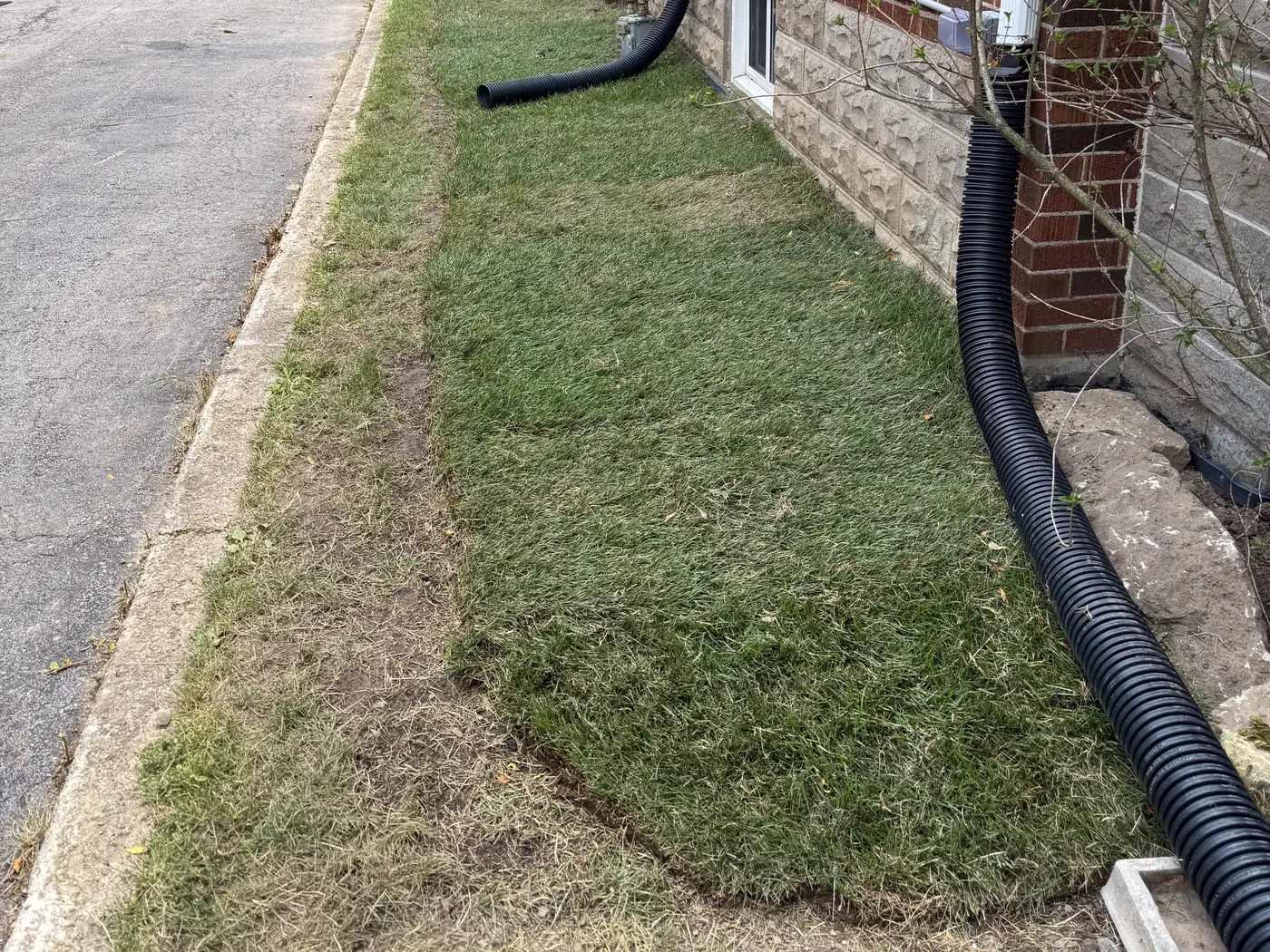
Yard Drainage in Hamilton: Swales, French Drains and Downspouts
Grading gets the yard level and sloped. Drainage is where the water goes once it leaves. The fixes we use, which one suits which symptom, and the City rules about swales and neighbours. Lumen Landscaping fixes yard drainage across Hamilton: call (905) 906-0671 or send the form for a free written quote.
- Fully insured
- 1-year craftsmanship warranty
- Hamilton owned and operated
Quick to quote, quick to start, we answer every call.
Serving Hamilton, Burlington, Oakville and the wider region, from Guelph to Niagara.
Get your fast, free quote
We reply fast, usually within the hour.
Yard drainage
Yard drainage in Hamilton: where the water goes once it leaves
A puddle in the back corner that takes three days to dry. A side yard you cannot walk down in April. Water sitting against the foundation after every storm. Ice across the walk all January. They look like four problems, but they are one: water arriving faster than the ground can take it, with nowhere to go. Our grading page is about shaping the ground so water moves. This page is about where it moves to.
In Hamilton that question is harder than it sounds. Much of the city sits on clay, which holds water and heaves when it freezes. On the Mountain, in Binbrook and across the Haldimand clay plain south of the escarpment, water cannot soak down, so it has to be carried sideways to somewhere it can leave: the street, a swale, a catch basin, a low corner of the lot that is allowed to be wet. A wet corner on clay stays wet until someone gives the water a route.
The fixes we use are below, and most yards need one or two of them, never all of them. Call (905) 906-0671 or send the form with a photo taken after a rain, and we will tell you which, with a visit when the yard needs one.
Our Work
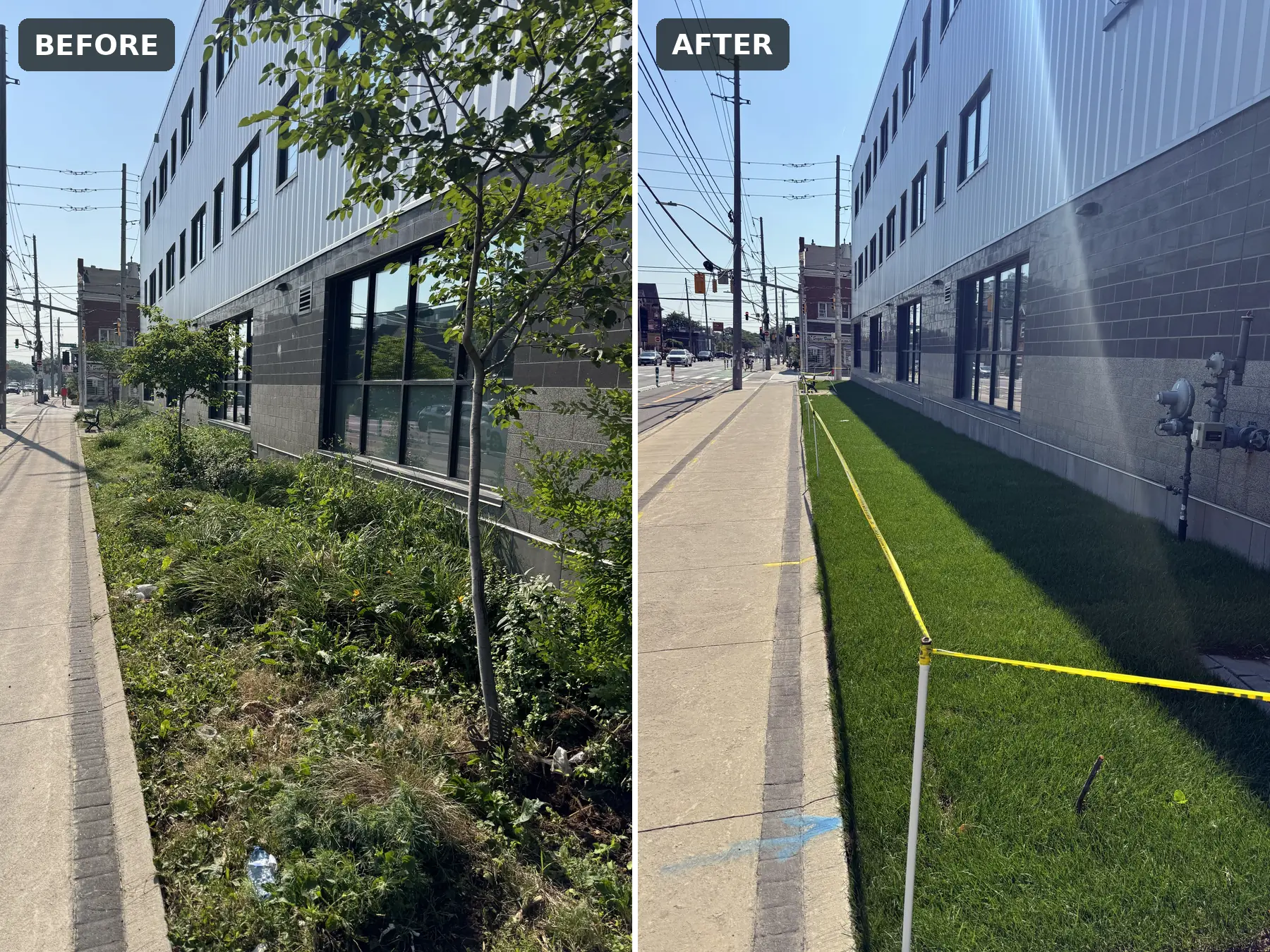
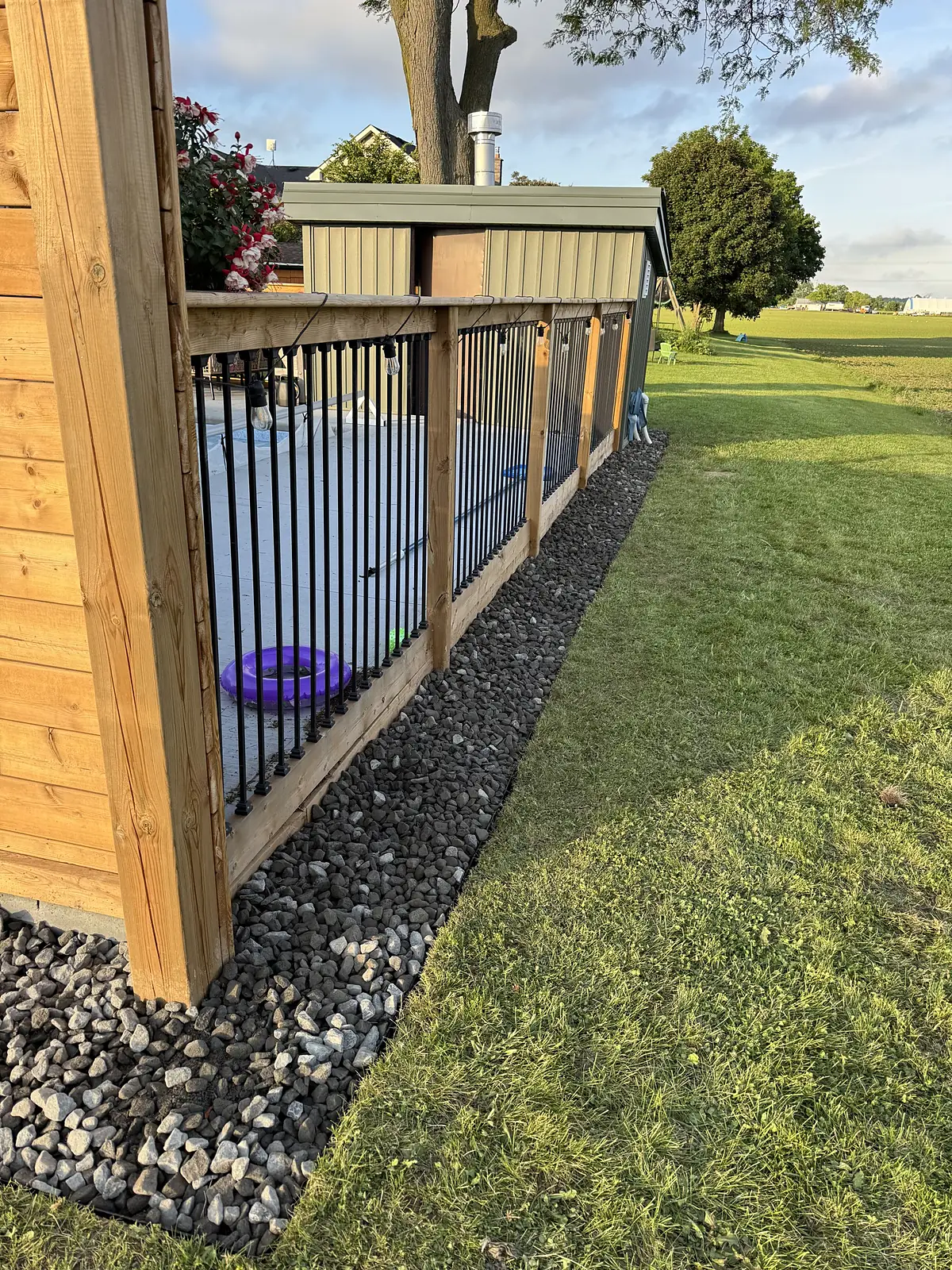
Graded and finished yards from our crew



The fixes, and which symptom each one is for
Every one of these ends the same way. We dig, we lay the pipe or shape the ground, and then we put the yard back: new sod, a bed or river rock over the work.
- Regrading: The ground reshaped so it falls away from the house and toward where water can leave. For water against the foundation, a lawn that holds puddles, or a yard that was never graded right after the builder left.
- Swales: A shallow grassed channel along a lot line or across the back that carries water to the street or a catch basin. For runoff arriving from a neighbour's yard, or a back yard with no low side. On a Hamilton subdivision lot the swales were part of the approved grading and are not to be filled or blocked; we repair and reshape them rather than remove them.
- French drains: A trench with perforated pipe in clear stone, wrapped in filter cloth, that collects water along a wet strip and carries it to an outlet. For a soggy side yard, the low edge of a patio, or the foot of a slope.
- Dry wells, where the soil allows: A buried pit of clear stone, or a perforated chamber, that takes the water from a downspout or a drain and lets it soak away slowly underground. For roof water on a lot with no low side and no route to the street. It only works in ground that drains: in heavy clay a dry well fills and stays full, so we check the soil before we suggest one, and on clay we carry the water somewhere else.
- Yard catch basins: A grated box set at the low spot that takes surface water into solid pipe and carries it to an outlet. For a low corner, or a patio edge where water collects and cannot be graded away. If your lot already has a City rear yard catch basin, we keep it clear and grade to it, never over it.
- Weeping tile: Perforated pipe at the base of a wall or along the edge of a hardscape, taking water away from a structure. For water pooling beside the foundation or behind a retaining wall. Interior weeping tile and sump pumps are a waterproofing contractor's job, and we say so.
- Eavestrough and downspout drainage: The cheapest fix and often the first. The water off the whole roof comes down a few downspouts, and one emptying beside the foundation feeds every other problem on this list. We extend it to daylight well away from the house, or run it underground in solid pipe to a swale, a dry well or a drain that carries it off, and make sure it does not land on the walk, the driveway or the neighbour.
- Then we put the yard back: Trenches backfilled and compacted, the grade set, and the surface finished in new sod, a bed or river rock so the yard looks like a yard again.
Google reviews
What our customers say
“The team did an excellent job re-sodding our backyard. They were professional, careful working around our pool, and the finished result looks fantastic.”
“I recently had Lumen remove the surface of our weed-infested lawn and replace it with fresh sod on the larger of two areas, and river rock on the smaller area. It was a pleasure dealing with Jeff at Lumen.”
“Excellent experience with Lumen Landscaping. Efficient, knowledgeable, hardworking, and my lawn looks fantastic. Highly recommend! I had Lumen landscape a second project one year later. Same terrific experience.”
Step by step
How a drainage job goes, step by step
Drainage is a diagnosis first and digging second. This is how we work through it.
- The visit, after a rain if we can: We walk the lot, find where the water collects and where it could leave, follow every downspout, and check the lot line for a swale that has been filled.
- The plan and the written quote: Which of the five fixes, where the pipe runs, where the outlet is and what the surface will be when we are done, each on its own line.
- Locates and the by-law check: Ontario One Call marks the buried gas, hydro and telecom lines before any trench is dug; it is free. Hamilton's site alteration by-law lets routine landscaping go ahead without a permit when no more than 15 cm of fill is added anywhere, drainage onto neighbours does not change and no swale is altered or blocked. We keep the work inside those limits, or tell you a permit is needed.
- Digging and pipe: Trenches cut to a fall, pipe laid in clear stone with filter cloth, downspouts tied in, the outlet built.
- Backfill and grade: The trenches backfilled and compacted so they do not settle into a dip, then the grade set so the surface sheds water to the same place the pipe does.
- The finish and the first storm: New sod, bed or rock over the work. We ask you to watch the first heavy rain and call us if anything still sits.

Why Hamilton homeowners choose Lumen for drainage
We do the grading, the drainage and the lawn, so nobody has to coordinate three contractors around one wet corner. You get a fast reply, a written quote that says which fix and why, and the same crew from the first call to the new sod.
- Materials at cost, no markup: You pay what the pipe, stone, soil and sod cost us; the contractor discount is passed straight to you.
- 1-year craftsmanship warranty: If something we built moves or fails within a year because of how we built it, we come back and make it right.
- Fully insured: Liability coverage on every job, so your home is protected while we work.
- Over 40 five-star Google reviews: Local homeowners rate us five stars, and you can read every review on Google.

Planning
What to know before you start: the City, the neighbour and the clay
Lot grading is yours to keep. When a Hamilton subdivision is built, the City approves a grading plan for every lot, and the homeowner is responsible for keeping it. Filling or blocking a swale can pond water on your lot or the neighbour’s and flood in a heavy rain. The City’s Lot Grading staff can be reached at 905-546-2489 if you want the approved plan for your lot.
The neighbour. Water from your yard cannot be sent onto a neighbour’s, and theirs should not come onto yours. A shared swale on the lot line is the usual answer, and we are happy to talk to the neighbour with you. Read runoff from the neighbour’s yard.
Downspouts. Hamilton’s sewer and drain by-law now includes a section on the required disconnection of downspouts in parts of the city, to keep roof water out of the sewers. A disconnected downspout needs somewhere safe to drain, and that is drainage work: an extension to daylight, or a drain that carries it away from the house and off the walk. The City’s own advice for a disconnected downspout is water that runs onto grass or a garden, away from the foundation, off the walkway and the driveway and not onto the neighbour’s lot, with the eavestroughs clean and the ground sloping away from the house for at least a metre. We build to the same standard.
Not included. Anything inside the foundation: interior weeping tile, sump pumps and basement waterproofing are a waterproofing contractor’s job. A connection to a municipal storm sewer needs the City’s approval. Our retaining walls include their own drainage behind the wall.
What affects the price.
- How far the water has to travel to an outlet
- Pipe, stone and fabric, billed at cost
- How much regrading comes with it, and how much soil has to move
- The surface you want back: sod, a bed or river rock
- Access for a mini excavator, or hand digging behind a narrow gate
The season. Spring to fall. Spring is when the problem shows and fall is when the ground is easiest to work; either is fine, and new sod goes down best in both.
Service Areas
Where we fix yard drainage
Hamilton is home: Hamilton, Ancaster, Dundas, Stoney Creek, Waterdown, Mount Hope, Binbrook and Glanbrook and Flamborough. The newer subdivisions in Binbrook and Waterdown are where a builder's grade most often sends water the wrong way, and the clay plain south of the escarpment keeps it there. We also work in Burlington, Grimsby, Oakville, Mississauga, Cambridge and Guelph, wherever the work is. See all our service areas.
Related
Start from what you are seeing
The symptom pages: water pooling in the yard after rain, water draining toward the house, runoff from the neighbour's yard and ice on the walkway every winter. Related: grading, sod and lawns and retaining walls. Guide: why correct grading and drainage prevents ice damage.
FAQs
Yard drainage questions
Give it somewhere to go. Water that sits for a day after rain is arriving faster than the ground can take it, and the fix is usually one or two of the fixes on this page: regrading, a swale, a French drain, a catch basin, or a dry well where the soil drains. Send us a photo taken after a rain and we can often tell you which before anyone digs; read water pooling in the yard.
Look at where the water sits. If it sits in a broad low area or against the house, the ground is shaped wrong and regrading fixes it. If it sits in a strip, a side yard or the foot of a slope, with nowhere lower to send it, a French drain carries it out. Many yards need a little of both. We tell you which once we have seen the yard after a rain, in photos or on a visit.
It is a trench with perforated pipe laid in clear stone and wrapped in filter cloth, so water seeps in along its length and runs to an outlet: toward the street, a swale, a catch basin or a dry well. You need one when a strip of the yard stays wet and the ground cannot simply be shaped to shed the water on the surface. Without an outlet it is only a trench full of water, so the outlet is planned first.
Yes, if it has an outlet. In clay the water cannot soak away, so the drain has to carry it somewhere lower: the street, a catch basin, a dry corner. A French drain with no outlet is a trench full of water. The outlet is the first thing we look for.
Yes, and it is often the first fix. We reshape the soil so it falls away from the foundation toward a swale or a low spot where the water can leave, then finish it in new sod or a bed, and the City of Hamilton's own downspout advice asks for ground that slopes away from the house for at least a metre. Our yard grading page covers how it is done.
Yes, in two steps: first the water, then the driveway. We send the roof water somewhere else, with an extension or a buried pipe to the lawn, a swale or a dry well, then fix the sunken part: interlock is lifted, re-based and reset, and a dropped concrete panel is replaced on a compacted base. Read downspouts, eavestroughs and sinking driveways.
Yes, the yard side of both. We carry downspout and eavestrough water away from the house in buried pipe, lay weeping tile behind retaining walls and along hardscape edges, and fix the grading that sends water to the foundation in the first place. Replacing the weeping tile at the footing of the house is a foundation or waterproofing contractor's job, and we say so; read weeping tile for homeowners.
Yes, where the soil drains. A dry well is a buried pit of clear stone, or a perforated chamber, that takes water from a downspout or a drain and lets it soak away underground, but in heavy clay it fills and stays full. We check how your soil drains before we suggest one, and on clay we carry the water to a swale or a catch basin instead.
A swale along the shared line that carries the water to the street or a catch basin, or a French drain along the line if there is no fall. Water cannot be pushed back onto them, so the fix is a route for it. We will talk to the neighbour with you if that helps. Read runoff from the neighbour's yard.
We put it back. Trenches are backfilled and compacted so they do not sink into a dip, the grade is reset and the surface is finished in new sod, a bed or river rock. Our sod page covers the lawn side; it is the same crew.
No. On a Hamilton subdivision lot the swale is part of the grading plan the City approved, and filling or blocking it can flood your yard or the neighbour's in a heavy rain. We can reshape a swale that has silted up and grow it in better, and a shallow, well shaped swale mows like the rest of the lawn.
You are. The City of Hamilton says it is the homeowner's responsibility to keep the grading the City approved when the subdivision was built, which means not filling or blocking the swales along the lot lines, or the rear yard catch basin if your lot has one. The City's line for lot grading questions is 905-546-2489, and every drainage job we do works with that plan, not against it.
For the plumbing side, yes: the City of Hamilton's Protective Plumbing Program offers eligible homeowners a grant toward a backwater valve, disconnecting downspouts, and a sump pump put in with a backwater valve; call the City at 905-546-2489 to see if your home qualifies. That is plumbing work, and yard grading and drainage are not on the program's list of eligible work. The City's one-time grant for the July and August 2026 rainstorms does not cover landscaping, fences, driveways or retaining walls either.
Routine landscaping does not, as long as no more than 15 cm of fill is added anywhere, drainage onto neighbours does not change and no swale is altered or blocked. Anything bigger falls under the site alteration by-law and needs a permit. We keep the work inside the exemption where we can and tell you plainly when we cannot.
How it works
Getting started is easy
- 1
Call or send the form
Tell us what you have in mind. We reply fast, usually within the hour.
- 2
Get your free quote
We look at your project and send you a clear, written quote quickly.
- 3
We build it
We start quickly and back our craftsmanship with a 1-year warranty.
Get Free Quote
Get a Free Yard Drainage Quote
Tell us where the water sits and send a photo after a rain if you have one. We will work out where it can go, come out when the yard needs a look, and get back to you fast with a free written quote.