

My Walkway or Driveway Ices Over Every Winter
The same patch, every winter, no matter how much salt goes down. Ice forms where water sits in the fall, and that patch is showing you where the surface has dipped or tilted. Fix the water in October and the ice does not come back in January. Lumen Landscaping fixes icy walkways and driveways at the source across Hamilton: call (905) 906-0671 or send the form for a free written quote.
- Fully insured
- 1-year craftsmanship warranty
- Hamilton owned and operated
Quick to quote, quick to start, we answer every call.
Serving Hamilton, Burlington, Oakville and the wider region, from Guelph to Niagara.
Get your fast, free quote
We reply fast, usually within the hour.
The problem
What you are seeing
You know the spot. The sheet of ice by the front step that is there every morning from December to March, the strip across the driveway at the bottom of the downspout, the slab at the side door that is glass by the time anyone leaves for work. You salt it, it melts, it freezes again overnight. Someone in the house has already slipped on it once.
A winter symptom almost always has a fall cause. Ice forms where water sits, and water sits where the surface has dipped, where a slab tilts the wrong way, where a downspout empties across the walk, or where a step traps meltwater against it. The rest of the walkway dries after a rain. That one patch does not, and in January the same patch is ice.
Hamilton's freeze season runs from around late October to late April, so a wet spot gets about six months of freeze and thaw every year. Each cycle pushes the pavers a little further and the ice gets a little bigger. The fix is to find where the water is coming from and give it somewhere else to go, and the time to do it is before the ground freezes.
Our Work
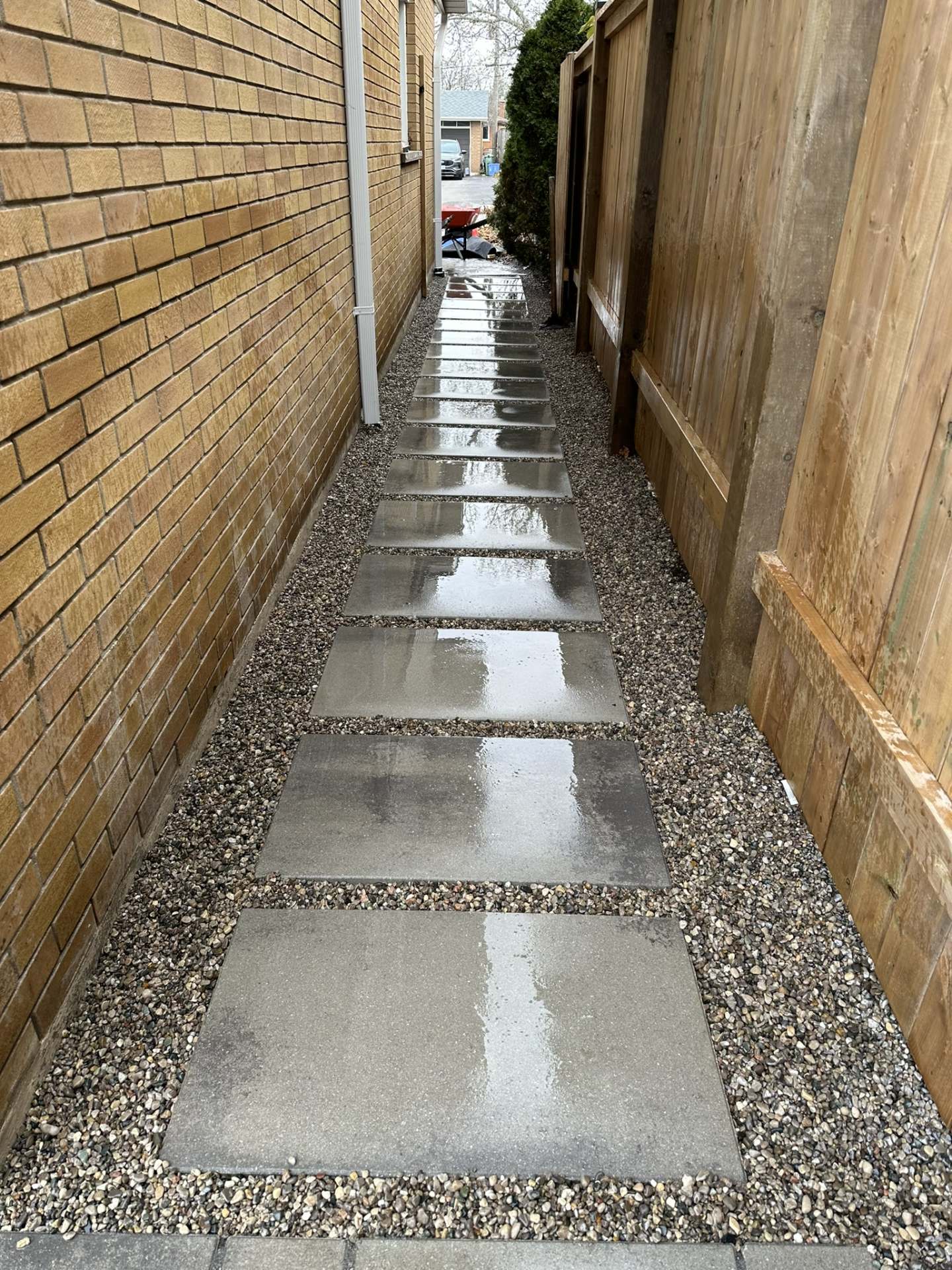
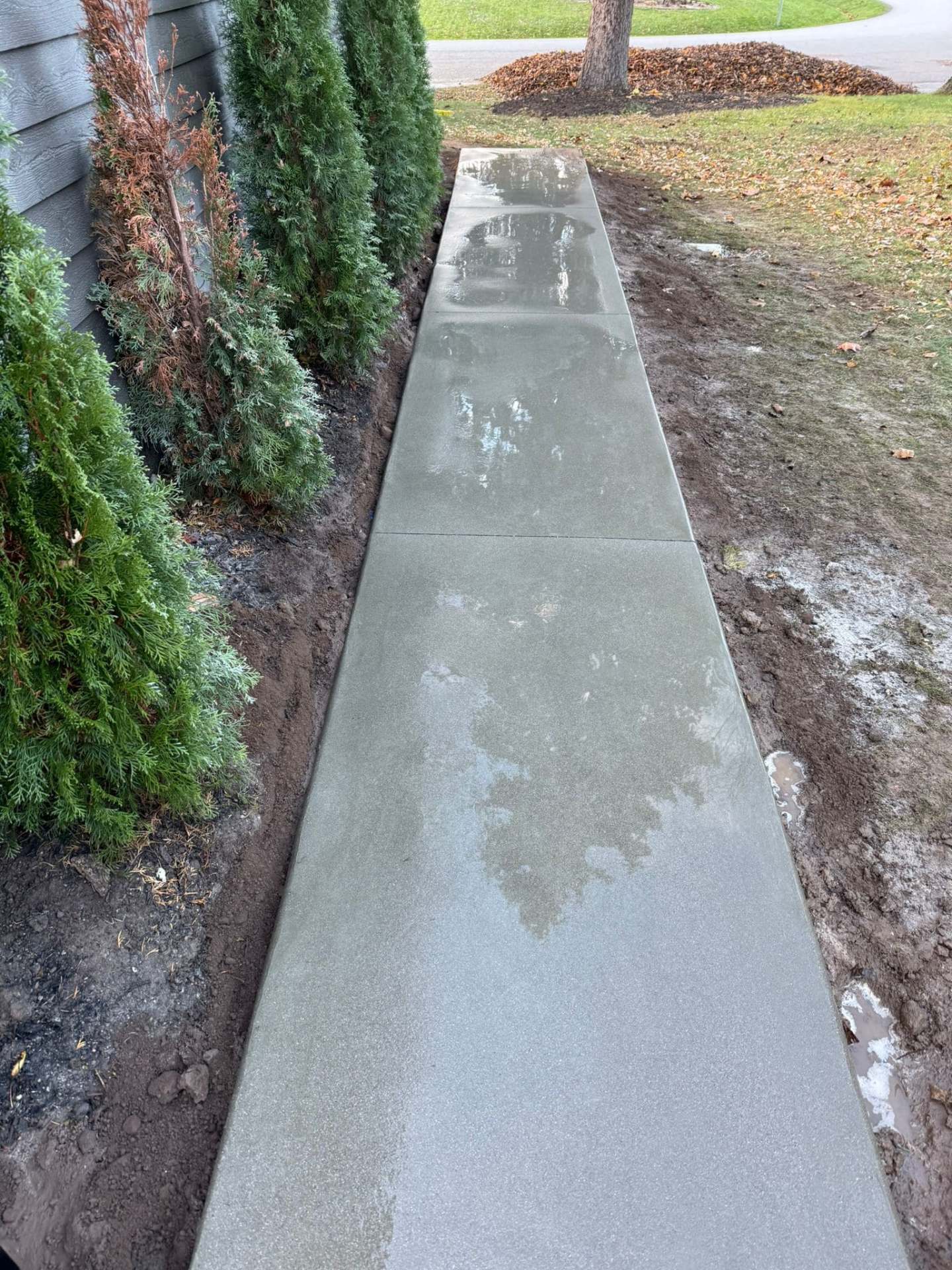
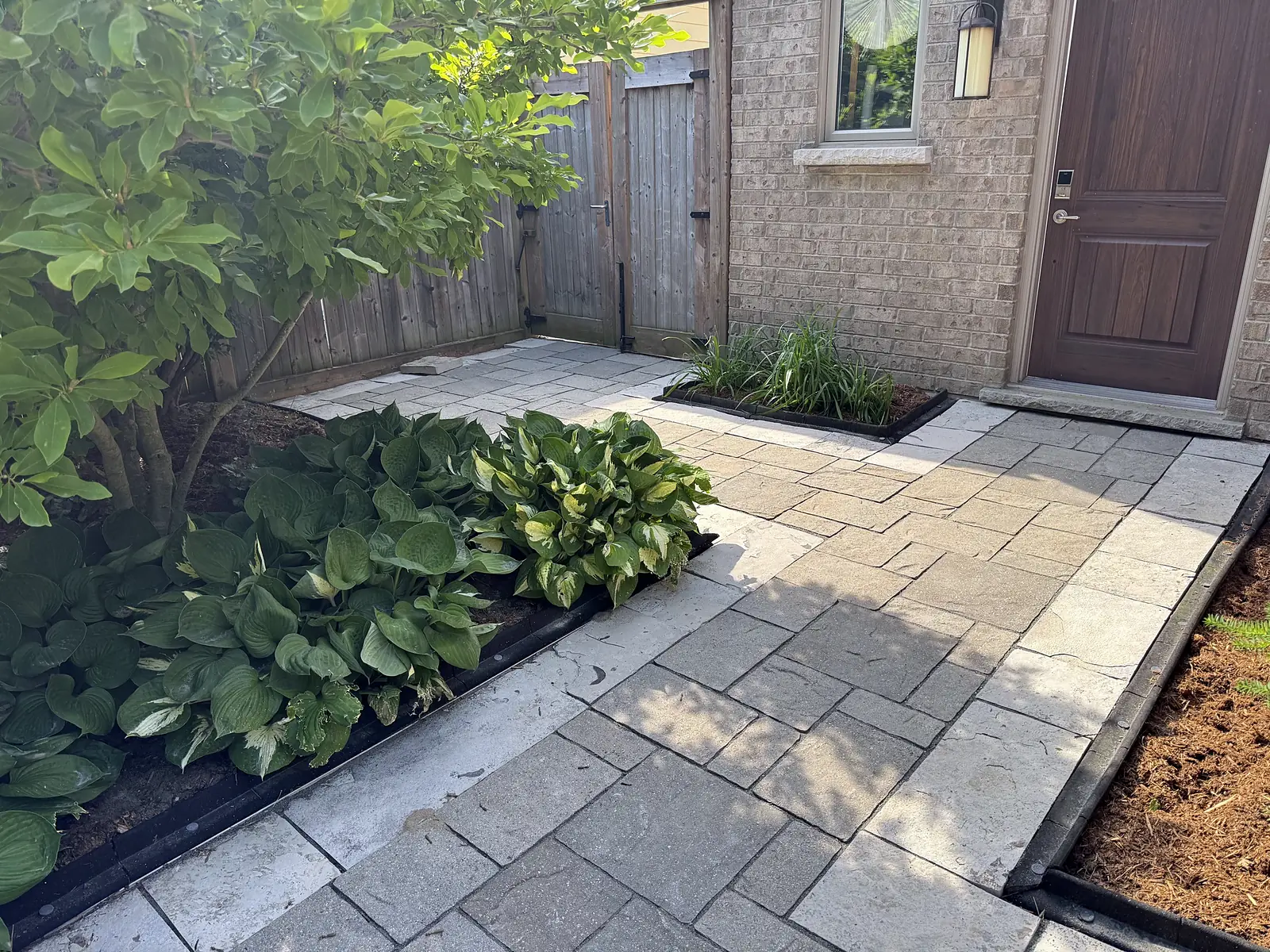
Walkways we have built and rebuilt

Why the same spot ices over
Stand on the ice patch in October with a hose running and you will usually find one of these.
- A dip in the pavers: Interlock that has settled in one area holds a shallow pool after every rain and every melt. On a sound base it drains. In the dip it freezes.
- A slab tilted toward the door: Concrete or a patio slab that has settled on the house side sends meltwater toward the step instead of away. The puddle forms right where you plant your foot.
- A downspout across the walk: A downspout that empties onto the walkway or driveway keeps that strip wet all winter. On a sunny afternoon the roof melts, the water runs across the walk, and at dusk it freezes.
- The step and the landing: Where a walkway meets a step, the walk often sits slightly low against the riser. Meltwater off the step collects in that seam and freezes along the whole width.
- Shade and the north side: A walk on the north side of the house, or under a big tree, gets no sun to dry it. In Dundas, with the escarpment on three sides of the valley, some front walks sit in shadow for most of a winter day.
- Snowbanks melting back: Snow piled along the edge of the walk melts from the bottom on warmer days and feeds the low spot beside it, then the whole thing refreezes overnight.
Google reviews
What our customers say
“We had a gravel walkway around our pool and equipment that had become overgrown with weeds, and grasses. The crew removed all the existing weeds etc., stone, and fabric. … We are very pleased with their work. They delivered as promised.”
“My front walk and back patio needed maintenance due to misaligned stones and weeds. … I am very happy with the result and greatly appreciate the owner's planting suggestions for the low maintenance gardens I require.”
“They returned my call the same day I phoned. He arranged a visit and gave me a few options to repair my stone stairs. He did the work within 2 weeks and did a great job. I highly recommend him.”
The fix
How we stop the ice for good
We start with the water, not the surface. If a downspout is feeding the spot, it gets extended or carried away underground so the walk never sees that water again. If the lawn beside the walk drains onto it, we regrade the edge so it drains away. Then we fix the surface. On interlock we lift the sunken pavers, correct and compact the base, re-screed the bedding with a slope away from the house, and reset the same pavers flush. On a slab walkway we lift and re-bed the tilted slabs the same way. Where a walk meets a step, we reset the first course so meltwater off the step runs along the walk and off it, instead of pooling in the seam. See our patio and walkway restoration service for how the re-levelling goes.
Sometimes the old walk cannot be saved: concrete that has broken into tilted pieces, or pavers laid straight on soil. Then we build a new one through our walkways and front entrances service, formed with the shape and the slope you choose so water leaves it on purpose, on a compacted base that will not settle into a new dip. When the whole yard sends water at the house, the walkway is one piece of a bigger drainage job, and our yard drainage page explains the swales, French drains and downspout work that go with it. We also wrote a longer piece on how grading and drainage prevent ice damage.
A Hamilton note worth knowing: the Snow and Ice By-law makes the homeowner responsible for clearing the City sidewalk beside the property within 24 hours after a snowfall ends. A front walk that drains properly makes that chore smaller too, because less meltwater runs onto the sidewalk and refreezes there.

Check this yourself first
The best time to diagnose an ice problem is a rainy day in the fall, when you can watch the water do what the ice will do later.
- Mark the ice patch now: Chalk the outline of last winter's ice, or take a photo of where it forms. Then stand there during a rain and watch where the water comes from and where it stops.
- Follow the downspouts: Trace every downspout to where it lets out. One that empties onto the walk or driveway, or within a few feet of it uphill, is probably the whole cause. Extending it is a quick win while you plan the real fix.
- Put a level on the slab: Lay a level on the slab or the pavers at the ice spot. If the bubble says it falls toward the house, the slope has reversed and the surface has to be re-set, not just salted.
- Check the seam at the step: Look at where the walk meets the bottom riser. A gap, a lip, or a strip of damp that outlasts the rest of the walk means water is pooling in that seam.
- When to call: A spot that ices every winter, a slab that tilts toward the door, or a walk that someone has already slipped on is worth fixing this fall. Call (905) 906-0671 and we will take a look before the ground freezes.

Planning
What a lasting fix includes, and what changes the price
A lasting fix always includes
- Finding where the water comes from before touching the surface
- Downspouts extended or carried away from the walk
- Sunken pavers or slabs lifted, the base corrected and compacted, and the surface reset with a slope away from the house
- The seam at the step re-set so meltwater runs off instead of pooling
- Joints refilled with polymeric sand so the fix stays tight
What affects the price
- How much of the walk or driveway has settled: one slab, one dip, or the whole run
- Whether the existing pavers or slabs can be reused or the walk needs rebuilding
- How far the downspout water has to be carried, and whether that means a buried line
- Regrading the lawn edge beside the walk, and new sod where we have dug
- Steps: resetting one course or rebuilding the step and landing
- Access to the spot for base material and the compactor
A typical fix, in plain words. Picture a front walk in Hamilton with a dip two slabs from the step and a downspout letting out beside it. We extend the downspout past the walk into the lawn, lift and re-bed the two low slabs with the right slope, reset the course against the step, and re-sand the joints. The following winter the walk is simply dry where it used to be ice. On an Ancaster lot where the walk runs down a slope to the street, the same job pays more attention to where the water goes at the bottom, so it does not just move the ice to the sidewalk.
Every quote is written and free, and materials are billed at what they cost us with no markup.
Related
Related pages
Services: walkways and front entrances, patio and walkway restoration and yard drainage. Related problems: an uneven interlock driveway and a cracked or sunken concrete walkway. Areas: Hamilton and Dundas. More answers on our FAQ page, and more problems we fix.
FAQs
Icy walkway questions
Because water sits there and nowhere else. A dip, a slab tilted toward the house, or a downspout emptying nearby keeps that patch wet after everything else has dried. When the temperature drops, the wet patch is the ice patch. Fix the water and the ice goes with it.
Not properly. Frozen ground cannot be compacted, and polymeric sand will not set in the cold. We can extend a downspout any time, which often helps right away, and we book the re-levelling for spring or fall. The best time to call is October.
Usually neither. It is what is under them. Pavers settle when the base was thin or wet. Concrete tilts when it was poured on soil with no base. Both can be lifted and reset, or replaced on a base that drains, depending on their condition.
Salt is hard on concrete and on paver colour over time, and it does nothing about the cause. A walk that drains needs far less of it. If you have new concrete, keep de-icers off it through its first winter and use sand for grip.
In Hamilton, yes. The Snow and Ice By-law gives the homeowner 24 hours after a snowfall ends to clear the sidewalk beside the property. A front yard and walk that drain away from the sidewalk make that easier, because less meltwater refreezes on it.
Then the walkway is one symptom of a grading problem, and we fix the grade first. Regrading, a swale or a French drain sends the water away from the foundation, and the walk is re-set as part of that job. Our yard drainage page explains each fix.
How it works
Getting started is easy
- 1
Call or send the form
Tell us what you have in mind. We reply fast, usually within the hour.
- 2
Get your free quote
We look at your project and send you a clear, written quote quickly.
- 3
We build it
We start quickly and back our craftsmanship with a 1-year warranty.
Get Free Quote
Get a Free Quote to Stop the Ice
Tell us where the ice forms and send a photo if you have one. We will take a look, tell you where the water is coming from, and get back to you fast with a free written quote.