

My Concrete Walkway Has Cracked and Sunk
Hairline cracks are normal and nobody should sell you a new walk for them. A slab that tilts, a lip you trip on, a corner that has dropped is a different story. Here is how to tell the two apart, and what a walk that lasts is built on. Lumen Landscaping rebuilds cracked and sunken concrete walkways across Hamilton: call (905) 906-0671 or send the form for a free written quote.
- Fully insured
- 1-year craftsmanship warranty
- Hamilton owned and operated
Quick to quote, quick to start, we answer every call.
Serving Hamilton, Burlington, Oakville and the wider region, from Guelph to Niagara.
Get your fast, free quote
We reply fast, usually within the hour.
The problem
What you are seeing
Some of it you can live with. Thin cracks that run across the walk, both sides still level, are what concrete does as it cures and as the seasons move it. Every sidewalk in the city has them. What you cannot live with is the slab by the step that has tilted so one edge stands proud, the section that has dropped and holds a puddle, the crack where one side is now higher than the other and catches a toe. Someone trips on it every winter. The mail carrier steps around it. And each spring it is a little worse.
The difference between the two is what is underneath. Concrete poured over a compacted gravel base with wire mesh inside cracks a little and stays where it is. Concrete poured on raked soil, with nothing inside it, breaks into pieces that move on their own, because the ground under it softens, settles, and heaves when it freezes, and each piece follows the ground under it.
So the question is never just can the crack be filled. It is whether the walk has a base. If it does not, the honest fix is a new walk, and the choice is between concrete and interlock.
Our Work
Walkways and entrances we have built and rebuilt
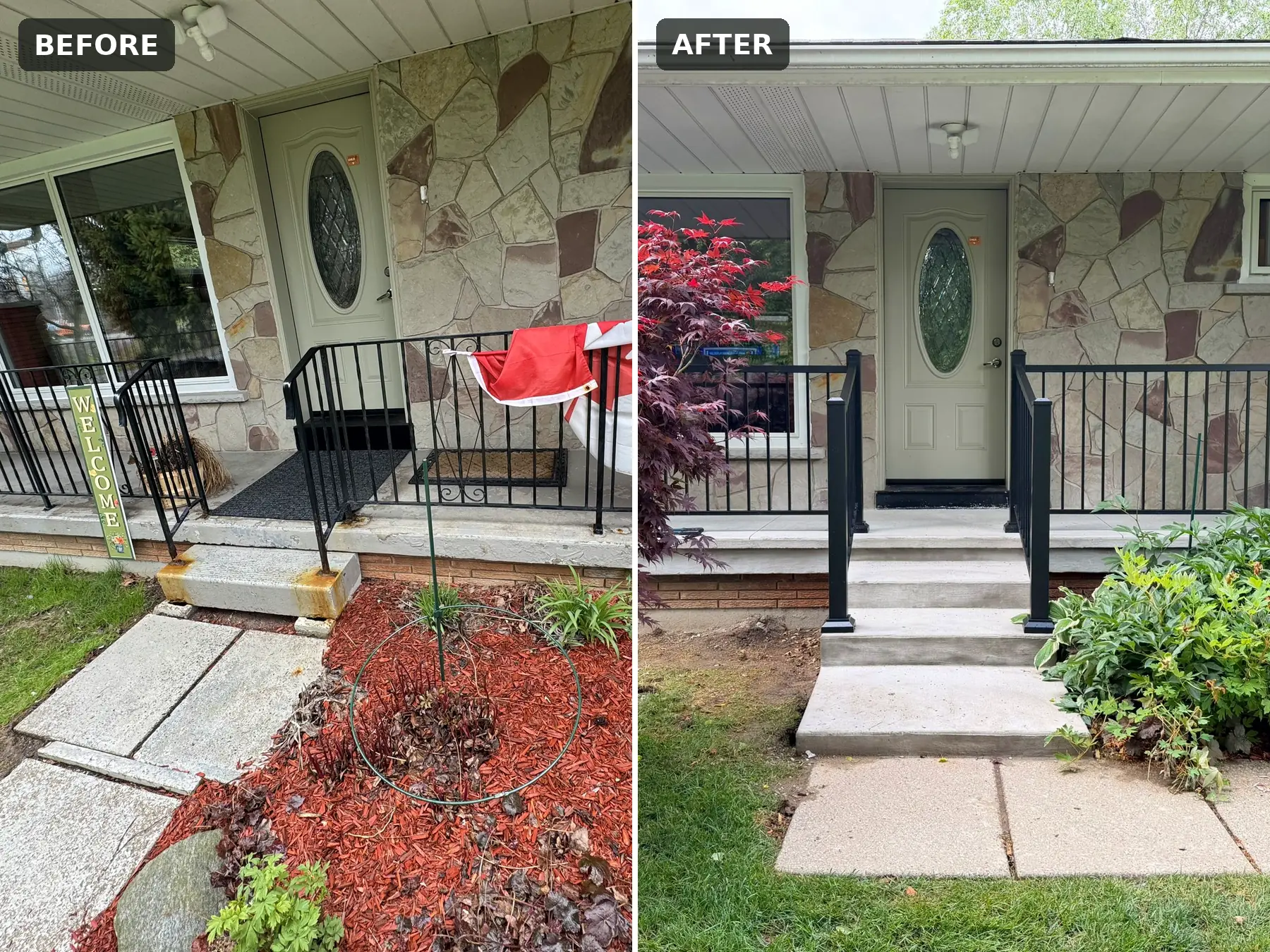
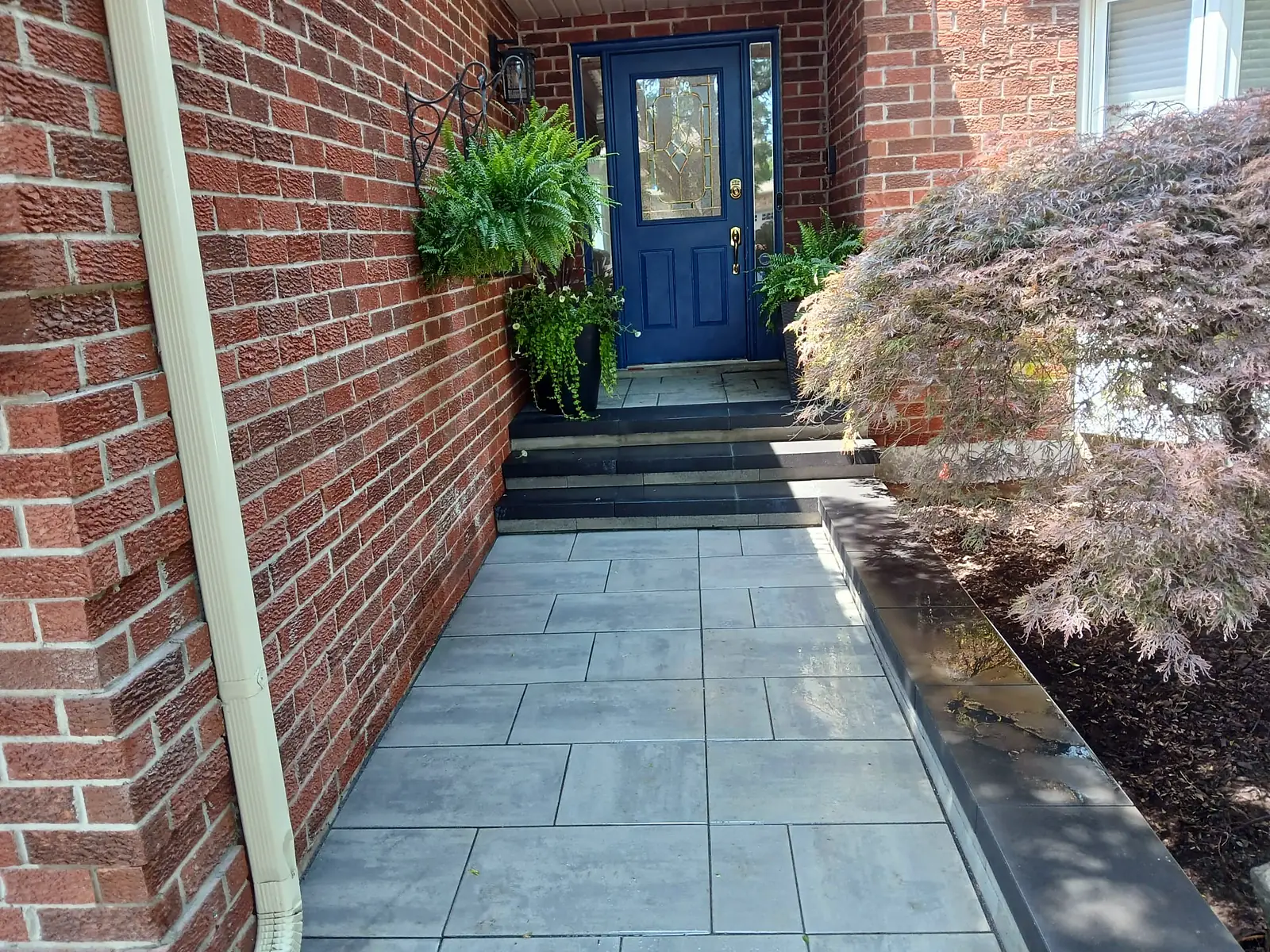

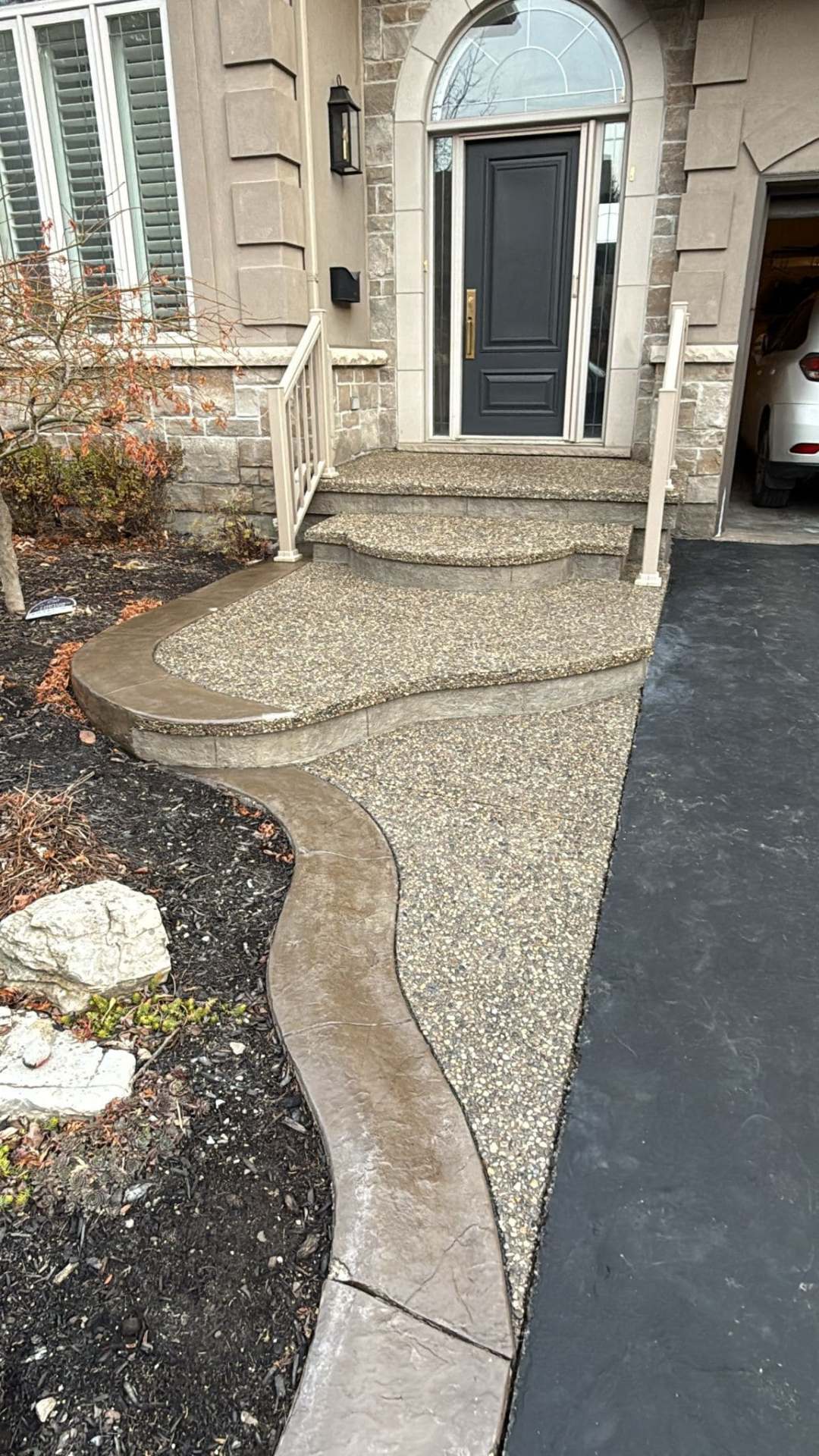
Why a concrete walkway cracks and sinks
When we break out an old walk, we can usually see the cause in the first wheelbarrow.
- No base: The walk was poured straight on soil. Soil settles, washes out and heaves when it freezes, and a slab on it goes along for the ride. A compacted aggregate base is what keeps a slab still.
- No reinforcement: Without wire mesh inside, concrete has nothing to hold it together when it cracks. Each piece becomes its own slab and settles at its own rate, which is where the lips and tilts come from.
- Too thin: A walk poured thin to save concrete cracks under the first winter and breaks under the first heavy thing wheeled across it.
- No stress joints: Concrete shrinks as it cures and moves with the seasons. Joints cut at the right spacing give it a place to crack neatly. Without them it cracks wherever it likes.
- Tree roots: A maple or a spruce near the walk sends roots under it looking for water. As the root thickens, it lifts the slab. The crack is usually right over the root, and the raised side points at the tree.
- Water washing out the base: A downspout emptying beside the walk, or a lawn that drains under it, carries the fine material out of whatever base there was, and the slab drops into the gap.
Google reviews
What our customers say
“The crew at Lumen Landscaping did an amazing job pouring our concrete patio last September. The entire experience was positive from beginning to end. The owner was honest, professional, and clearly takes great pride in his work.”
“We recently hired Lumen Landscaping to build a stone patio in our backyard, a concrete pad for our shed. … The owner is professional and highly knowledgeable, providing great advice and solutions for a reasonable price.”
“They built a concrete slab for our new backyard shed and also cleaned up a side garden area that needed a refresh. … Prices are reasonable and results are great. He's our go to person for outdoor landscaping work.”
The fix
How we rebuild a cracked or sunken walkway
A walk that has broken into moving pieces does not get patched. We break it out and haul the rubble to a licensed disposal site, excavate the soil and sod as needed, and install a 4 inch compacted aggregate base. Then 10 gauge wire mesh reinforcement goes in throughout, and 32 MPa concrete is poured 4 inches or more thick with a brush finish. We form the walkway with the shape you prefer, with a raised step and landing and a bull nose on the step where you want one, cut stress joints to control cracking, strip the forms and clean the concrete, and place soil along the edges where the form boards were so there are no gaps or trenches left behind. That is the scope on our concrete page, and the same base and mesh go under our concrete driveways, only deeper.
The other answer is interlock. A paver walkway goes down on the same kind of compacted base, and it has one advantage concrete cannot match: if a section ever settles or a root lifts it, we lift those pavers and relay them, instead of breaking out a slab. It also comes in far more looks, and the pavers are billed at cost with the builder supply discount passed to you. Our walkways and front entrances page lays the two side by side, and we are happy to quote both so you can compare.
Two things are not ours to touch. The City sidewalk along the street belongs to the City, in Hamilton and everywhere else we work, so a lifted public sidewalk is a call to the municipality, not to us. And a boulevard tree is the City's too, so a root under your walk gets built around, not cut. If a private tree is the cause, see our page on tree roots lifting the walkway before deciding anything.

Check this yourself first
Five minutes with a straight board will sort the cosmetic cracks from the real problem.
- Lay a board across the crack: Put a straight board across a crack. If both sides touch it, the crack is cosmetic. If one side stands off the board, that section has moved, and a filler will not hold it.
- Find the lips: Walk the length of the path and feel for edges with your toe. A raised edge is a trip hazard and the clearest sign the slabs are moving separately.
- Watch it after a rain: Water standing on a section means it has dropped. Water running toward the house means the slope has reversed, which is the most urgent kind of settling.
- Look for roots and downspouts: Check whether a crack lines up with a tree, and whether a downspout lets out beside the walk. Both tell us what the new walk has to be built around.
- Count the joints: Look for the straight lines cut or tooled across the walk. A walk with no joints at all was probably poured without the base and mesh too.
- When to call: A lip you can catch a toe on, a slab tilted toward the door, or a section that holds water is worth fixing this season, before another winter of ice on it. Call (905) 906-0671 and we will take a look.

Planning
What a lasting walkway includes, and what changes the price
A lasting walkway always includes
- The old walk broken out and the rubble taken to a licensed disposal site
- A 4 inch compacted aggregate base
- 10 gauge wire mesh throughout
- 32 MPa concrete at 4 inches or more thick, brush finished, with stress joints cut
- A slope that sends water away from the house, and a step and landing where the grade needs one
- Soil placed back along the edges, so the lawn meets the walk cleanly
What affects the price
- The length and width of the walk, and its shape: curves and steps take more forming
- How much old concrete has to be broken out and hauled away
- A step and landing at the door, and a bull nose on the step
- Roots or a downspout that the new walk has to be built around
- Concrete or interlock, and the pavers you choose if interlock, billed at cost
- Access for the concrete delivery and the rubble going out
A typical job, in plain words. Picture a front walk in three tilted pieces with a step that has dropped at the door. It comes out in a morning. The base goes in and gets compacted, the mesh goes in, and the new walk is poured with a landing at the door and joints cut where they should be. A week later it is a walk again, and the lip someone tripped on all winter is gone. On the older streets of Galt in Cambridge, where the walks are often as old as the houses and the lots run toward the Grand River, the same job sometimes meets a water table close to the surface, and the base matters even more. In a newer subdivision in Waterdown, a walk that sank was usually poured on fill that had not finished settling, and the compacted base is what fixes that.
Every quote is written and free, and materials are billed at what they cost us with no markup.
Related
Related pages
Services: concrete, walkways and front entrances, concrete driveways and stamped concrete. Related problems: cracked concrete steps and tree roots lifting the walkway. Areas: Hamilton and Cambridge. More answers on our FAQ page, and more problems we fix.
FAQs
Cracked concrete walkway questions
Thin cracks with both sides level are normal. Concrete shrinks as it cures and moves with the seasons, and stress joints are cut to give it a tidy place to do that. A crack where one side has moved, a raised lip or a section that holds water is not normal, and it means the slab has no base holding it.
Sometimes, on a thick, sound slab, but a walk that was poured thin on soil with no mesh usually breaks when it is lifted, and the ground under it is still the problem. For most front walks, a new walk on a compacted base is the fix that lasts. We tell you honestly which yours is.
Both last when they are built on a compacted base. Concrete is simple and clean. Interlock can be lifted and relaid one section at a time if it ever needs a repair, and comes in more looks. We build both and will quote both so you can compare.
A 4 inch compacted aggregate base, 10 gauge wire mesh throughout, and 32 MPa concrete at 4 inches or more thick, with stress joints cut to control cracking. Skip any one of those and the walk starts to move within a few winters.
The municipality. The public sidewalk along the street belongs to the City, and so does a boulevard tree lifting it. Report it to the City. We build the walk from the sidewalk to your door, and we build around a boulevard tree, never through its roots.
Light foot traffic in a day or two, depending on the weather, and we tell you when. Keep de-icing salt off it through its first winter and use sand for grip, then seal it after a season so it resists salt and stains.
How it works
Getting started is easy
- 1
Call or send the form
Tell us what you have in mind. We reply fast, usually within the hour.
- 2
Get your free quote
We look at your project and send you a clear, written quote quickly.
- 3
We build it
We start quickly and back our craftsmanship with a 1-year warranty.
Get Free Quote
Get a Free Quote for a Walkway That Stays Put
Tell us how long the walk is and what it is doing, and send a photo if you have one. We will tell you whether it needs a new base, quote concrete and interlock side by side if you like, and get back to you fast with a free written quote.