

My Side Yard Is a Mud Path Where Grass Will Not Grow
A strip between the house and the fence that is shade, foot traffic and downspout water all at once. Grass loses there every time. A slab path, river rock or a sod strip that drains each work, and here is how to pick. Lumen Landscaping turns muddy side yards into paths, rock or sod across Hamilton: call (905) 906-0671 or send the form for a free written quote.
- Fully insured
- 1-year craftsmanship warranty
- Hamilton owned and operated
Quick to quote, quick to start, we answer every call.
Serving Hamilton, Burlington, Oakville and the wider region, from Guelph to Niagara.
Get your fast, free quote
We reply fast, usually within the hour.
The problem
What you are seeing
Everyone has one. The strip down the side of the house, between the wall and the fence, that is mud from March to May, dust in August and mud again in October. The grass gave up years ago. There is a worn line down the middle where the garbage bins go out, a puddle under the downspout, and a damp patch against the foundation that never quite dries. It is the path to the backyard, so you cannot avoid it, and it is too small and too dark to make into anything, so you ignore it.
It is a small space with a lot going against it. The house shades one side and the fence the other, so it gets a few hours of sun at best. Every trip to the backyard walks the same line. One or two downspouts empty into it. On a newer lot in Waterdown or on Stoney Creek Mountain, the side yard also carries the drainage swale that takes water from the backyard to the street, so it is wet by design. Grass needs sun, loose soil and a break from being walked on, and a side yard offers none of the three.
The fix is to stop asking grass to do a job it cannot do, and give the strip a surface that suits what it is: a path.
Our Work
Side yards and paths we have built
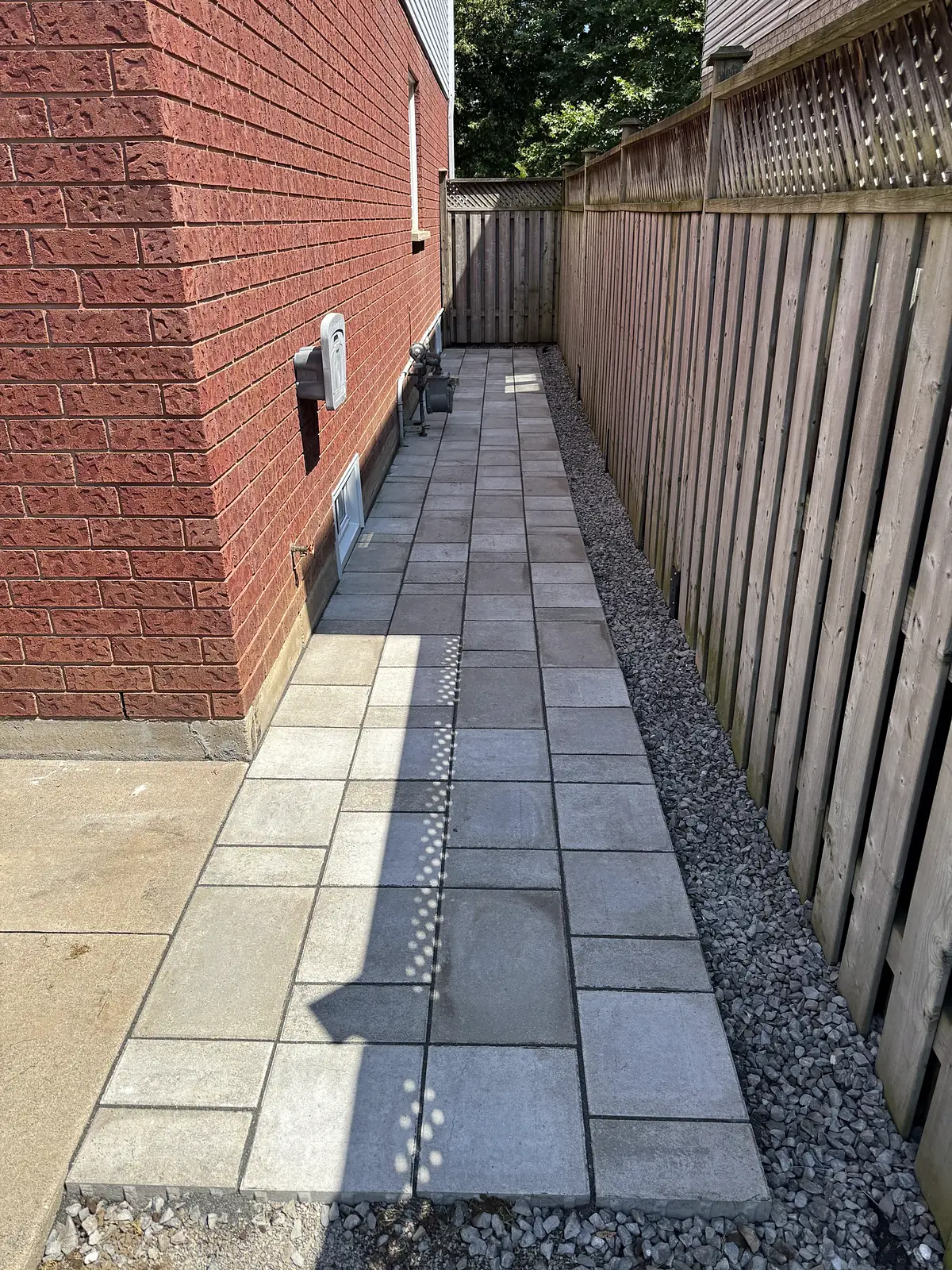
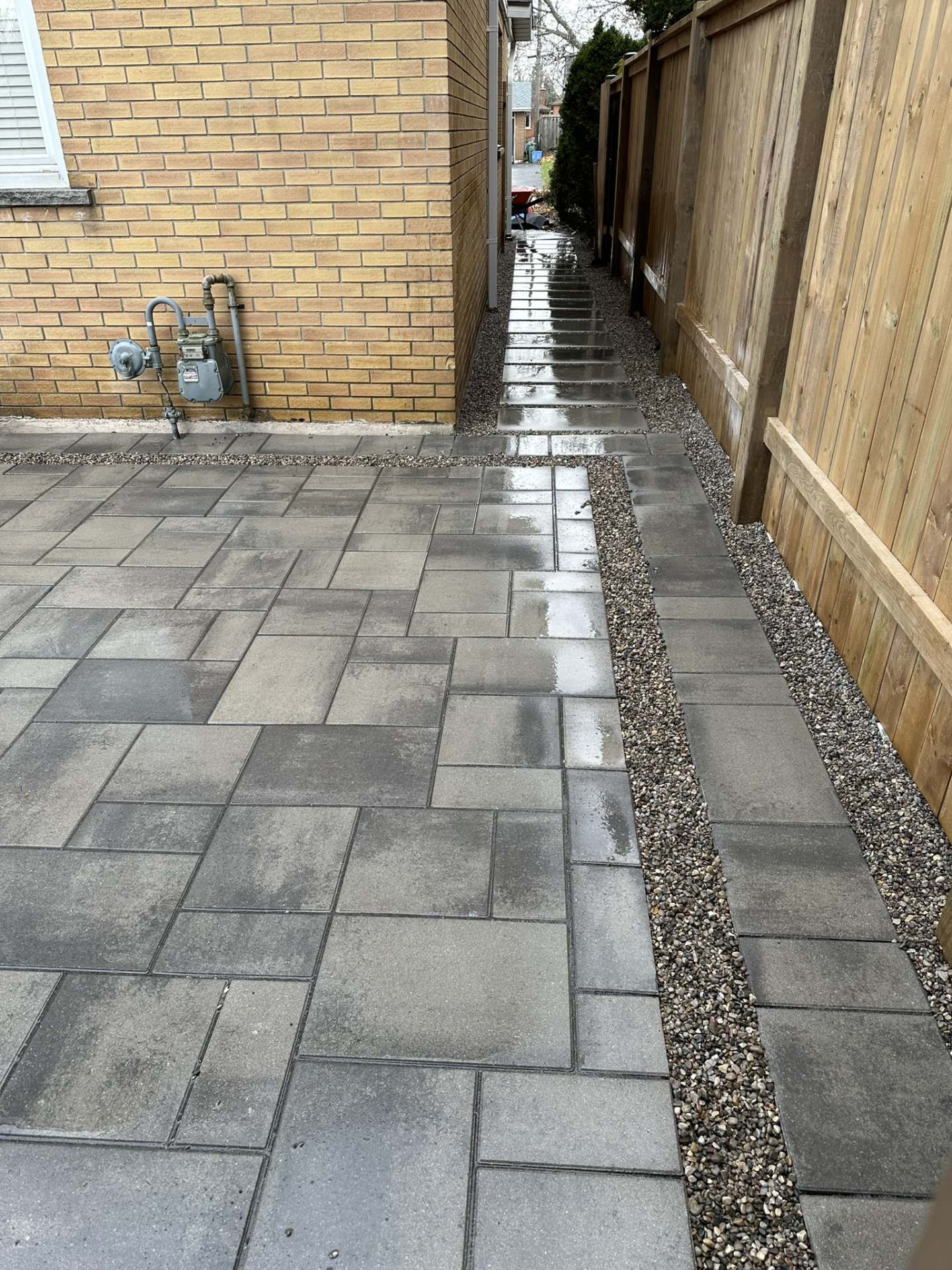

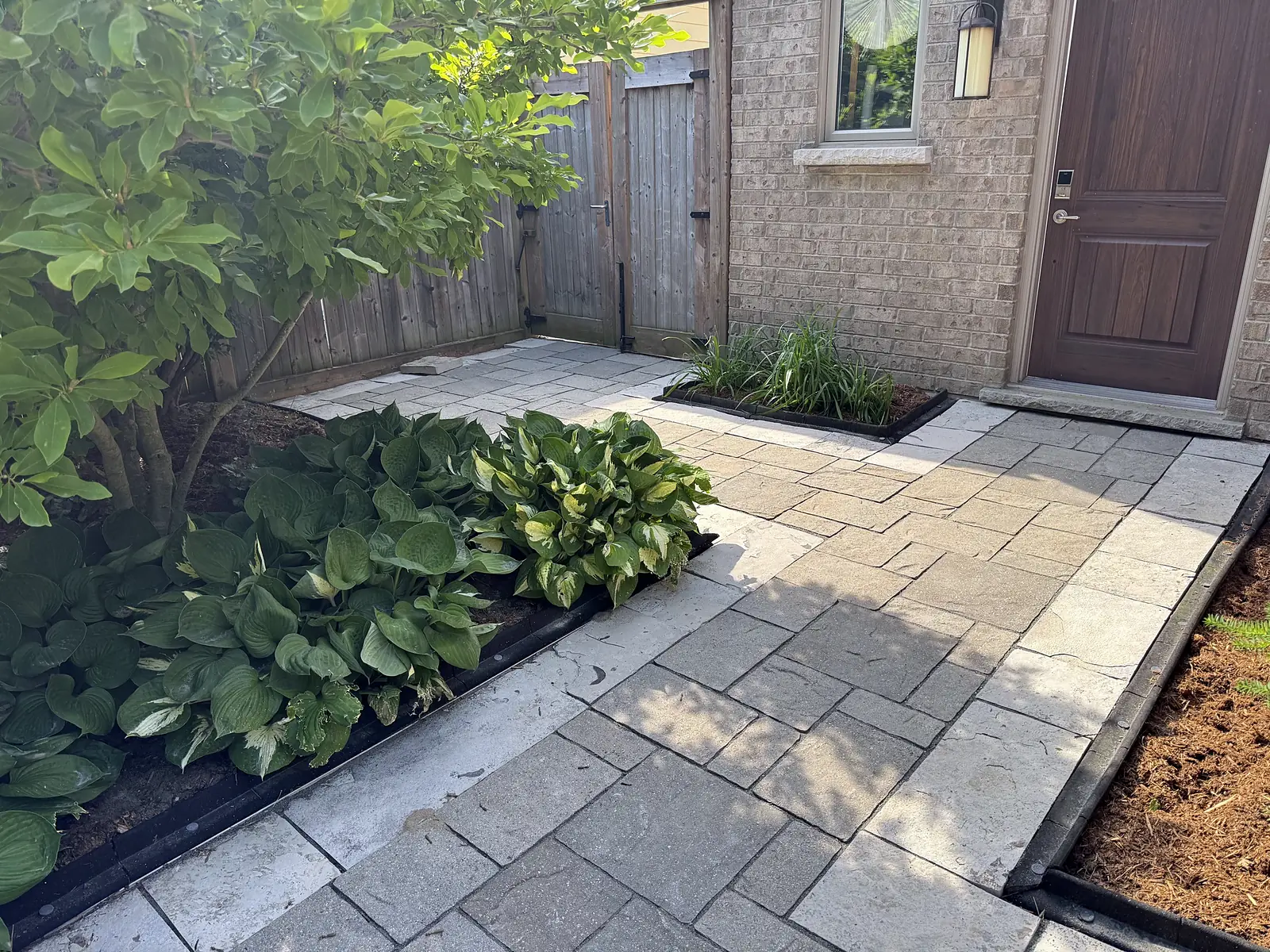
Why grass loses in a side yard
Any one of these will thin a lawn. A side yard usually has all of them.
- Shade on both sides: The house wall shades the strip for half the day and the fence for the other half. Lawn grasses need hours of direct sun, and a narrow side yard rarely gets them.
- One line of foot traffic: Every trip to the backyard, every bin and every wheelbarrow takes the same line. Soil packs hard under it, roots cannot push through, and the grass wears down to bare ground.
- Downspouts: A side yard is where downspouts end up. Each one dumps a roof's worth of water onto the same spot, which stays soft, grows moss and washes out whatever soil was there.
- The swale: On many lots the side yard is the drainage swale that carries water from the back of the lot to the street. It is meant to be wet after rain. Filling or blocking it ponds water and can flood the yard or the neighbour's.
- Clay underneath: Much of Hamilton sits on clay that holds water and packs hard when it is walked on wet. In a shaded strip it never dries enough to loosen.
- Nowhere for air or light: Air conditioners, meters, hose bibs and the gate all crowd the strip, so it is never left alone long enough for a lawn to recover.
Google reviews
What our customers say
“We had a gravel walkway around our pool and equipment that had become overgrown with weeds, and grasses. The crew removed all the existing weeds etc., stone, and fabric. … We are very pleased with their work. They delivered as promised.”
“My front walk and back patio needed maintenance due to misaligned stones and weeds. … I am very happy with the result and greatly appreciate the owner's planting suggestions for the low maintenance gardens I require.”
“They returned my call the same day I phoned. He arranged a visit and gave me a few options to repair my stone stairs. He did the work within 2 weeks and did a great job. I highly recommend him.”
The fix
Three ways we fix a muddy side yard
A slab path. The most used fix, because a side yard is a path. We excavate and dispose of the soil, install a 4 inch bedding base graded for drainage, stability and finished height, set 2 ft by 2 ft patio stones in the pattern you choose, and set everything with polymeric sand. With a gravel border either side it drains, it carries the bins and the wheelbarrow, and nothing ever has to be mowed. See our walkways and front entrances page for the slab and interlock options.
River rock or gravel. For a strip that is mostly drainage, or where you want the whole width covered, we excavate the old material, weeds and roots, install new premium landscape fabric across the whole area, and lay river rock or the decorative gravel you prefer. If there is clean rock already, it is set aside and reused along the bottom, topped with fresh. Stepping stones can be set into it for the walking line. Our garden bed cleanup, mulch and edging page covers the fabric and rock work, and if the fabric is already failing read our page on weeds growing through river rock first.
A sod strip that drains. Where the strip gets real sun and the only problem was water, we extend the downspouts past it, excavate the old grass, regrade so the swale still runs, and lay premium Kentucky bluegrass sod on fresh topsoil, rolled for contact, with a 12 month care plan. That is our sod and lawns service, and it is the right answer less often than people hope, but when it is, it is the cheapest.
Whichever one we build, the downspouts get dealt with first and the swale, if there is one, stays open. In Hamilton the homeowner is responsible for keeping the lot graded as it was approved, and filling a swale is how a side yard problem becomes a backyard pooling problem. In the old town in Dundas, where many lots have no side access at all, the strip is sometimes just wide enough for a path and a downspout, and the path is the whole answer.

Check this yourself first
Three quick checks decide which of the three fixes suits your side yard.
- Count the hours of sun: Look at the strip at midmorning, noon and midafternoon on a clear day. Fewer than a few hours of direct sun and sod is not a fair ask. A path or rock is.
- Find where the water comes in: Trace the downspouts and watch the strip in a rain. Water arriving from the roof can be carried away. Water flowing through from the backyard means there is a swale, and the fix has to keep it open.
- Look for the swale: A shallow dip running the length of the side yard, lower in the middle than at the house and the fence, is a drainage swale. It stays. Whatever we build in a side yard with a swale is shaped to let the water keep running.
- Measure the gate and the strip: The width of the gate decides whether a small machine fits or the work is done by hand. Either way it gets done. We have taken a machine through gates people were sure were too small.
- When to call: A side yard that is mud for half the year, a damp patch against the foundation, or a puddle that sits for days after rain is worth fixing this season. Call (905) 906-0671 and we will suggest the fix that fits.

Planning
What a lasting fix includes, and what changes the price
A lasting fix always includes
- Downspouts extended or carried away before anything is built
- The swale kept open, with the new surface shaped to let water run through
- A slab path on a compacted bedding base, set with polymeric sand
- River rock over new premium fabric, old clean rock reused at the bottom
- Sod only where there is sun to grow it, on real topsoil
- The strip left clean, with the bins and the gate working as before
What affects the price
- The length and width of the strip
- Which fix: slabs, rock, sod or a mix of path and rock
- How much old material has to come out, and how far it is carried
- The slabs or rock you choose, billed at cost
- Downspout work, and whether a line has to be buried
- Access: a machine through the gate or everything by hand and wheelbarrow
A typical job, in plain words. Picture a side yard with a worn mud line down the middle, a downspout at each end and a gate just wide enough for a person. We extend both downspouts to the back lawn, dig out the strip, bring the base in by wheelbarrow, set a slab path down the walking line and fill the rest with river rock over fabric. The strip drains, the bins roll, and the mud is gone for good. On one job the owner was surprised we got a machine through a small gate at all, and the lawn was mulch over weed barrier by the end of the day.
Every quote is written and free, and materials are billed at what they cost us with no markup.
Related
Related pages
Services: walkways and front entrances, garden bed cleanup, mulch and edging and sod and lawns. Related problems: water pooling in the yard and weeds in river rock. Areas: Hamilton and Dundas. More answers on our FAQ page, and more problems we fix.
FAQs
Muddy side yard questions
Shade from the house and the fence, one line of foot traffic that packs the soil, and downspouts keeping it wet. Lawn grass needs hours of sun, loose soil and a rest from being walked on. A side yard offers none of those, which is why a path or rock usually beats sod there.
A slab path if the strip is mainly the route to the backyard: it carries bins and wheelbarrows and stays clean. River rock if the strip is mainly drainage or you want the whole width covered, with stepping stones for the walking line. Many side yards get both, path down the middle and rock either side.
Often, yes. We have taken a small machine through gates people were sure were too narrow. When it does not fit, the work is done by hand and wheelbarrow, which takes longer but ends up the same. Your quote says which it will be.
It stays open. The swale carries water from the backyard to the street, and in Hamilton the homeowner is responsible for keeping the lot graded as it was approved. We shape the path or the rock so water keeps running through, and we never fill a swale to make a side yard look level.
Not for a long time, when it is laid over new premium landscape fabric with the old weeds and roots taken out first. Rock laid over bare soil or torn fabric becomes a weed bed within a season. The fabric is most of the job.
Yes, and it should be. Usually a downspout is emptying there or the strip slopes toward the house. We extend the downspout and grade the new surface away from the wall. If the whole yard drains toward the house, our yard drainage page covers the bigger fixes.
How it works
Getting started is easy
- 1
Call or send the form
Tell us what you have in mind. We reply fast, usually within the hour.
- 2
Get your free quote
We look at your project and send you a clear, written quote quickly.
- 3
We build it
We start quickly and back our craftsmanship with a 1-year warranty.
Get Free Quote
Get a Free Quote to Fix Your Side Yard
Tell us how long and wide the strip is, how many downspouts end up in it, and whether a machine could fit through the gate. We will suggest the fix that fits and get back to you fast with a free written quote.