

Concrete Driveways in Hamilton
A plain broom finish driveway done right outlasts a fancy one done fast. Four inches or more of 32 MPa concrete over a compacted base with wire mesh, stress joints cut on time, and an apron that meets the street the way the City wants. Lumen Landscaping builds concrete driveways across Hamilton: call (905) 906-0671 or send the form for a free written quote.
- Fully insured
- 1-year craftsmanship warranty
- Hamilton owned and operated
Quick to quote, quick to start, we answer every call.
Serving Hamilton, Burlington, Oakville and the wider region, from Guelph to Niagara.
Get your fast, free quote
We reply fast, usually within the hour.
Concrete driveways
Built the boring way, on purpose
Concrete driveways fail for dull reasons: too little base, no mesh, a pour that is thinner at the edges than in the middle, joints cut too late or not at all. None of that shows on the day it is poured. It shows two winters later as a crack across the apron and a slab that sits lower at the garage than it did. So the way we build a driveway is not exciting, and that is the point.
Here is the specification, in the words your quote uses: excavate and dispose of the old surface, soil and sod as necessary; install a 4 inch compacted aggregate base; install 10 gauge wire mesh reinforcement throughout; pour 32 MPa concrete at 4 inches or more thick, finished with a brush finish; cut stress joints to control cracking; strip the forms and clean the concrete; and place soil along the edges where the form boards were, so there are no gaps or trenches left behind.
32 MPa is not a number we picked. It is the strength Canadian concrete standards call for in flatwork exposed to freezing, thawing and de-icing salt (CSA A23.1 exposure class C-2), the same class municipalities specify for sidewalks and driveway entrances. Stamped, exposed aggregate and coloured finishes are covered on our concrete page; this page is the plain driveway, done right. Call (905) 906-0671 or send the form for a free written quote.
Our Work
More concrete from our crew
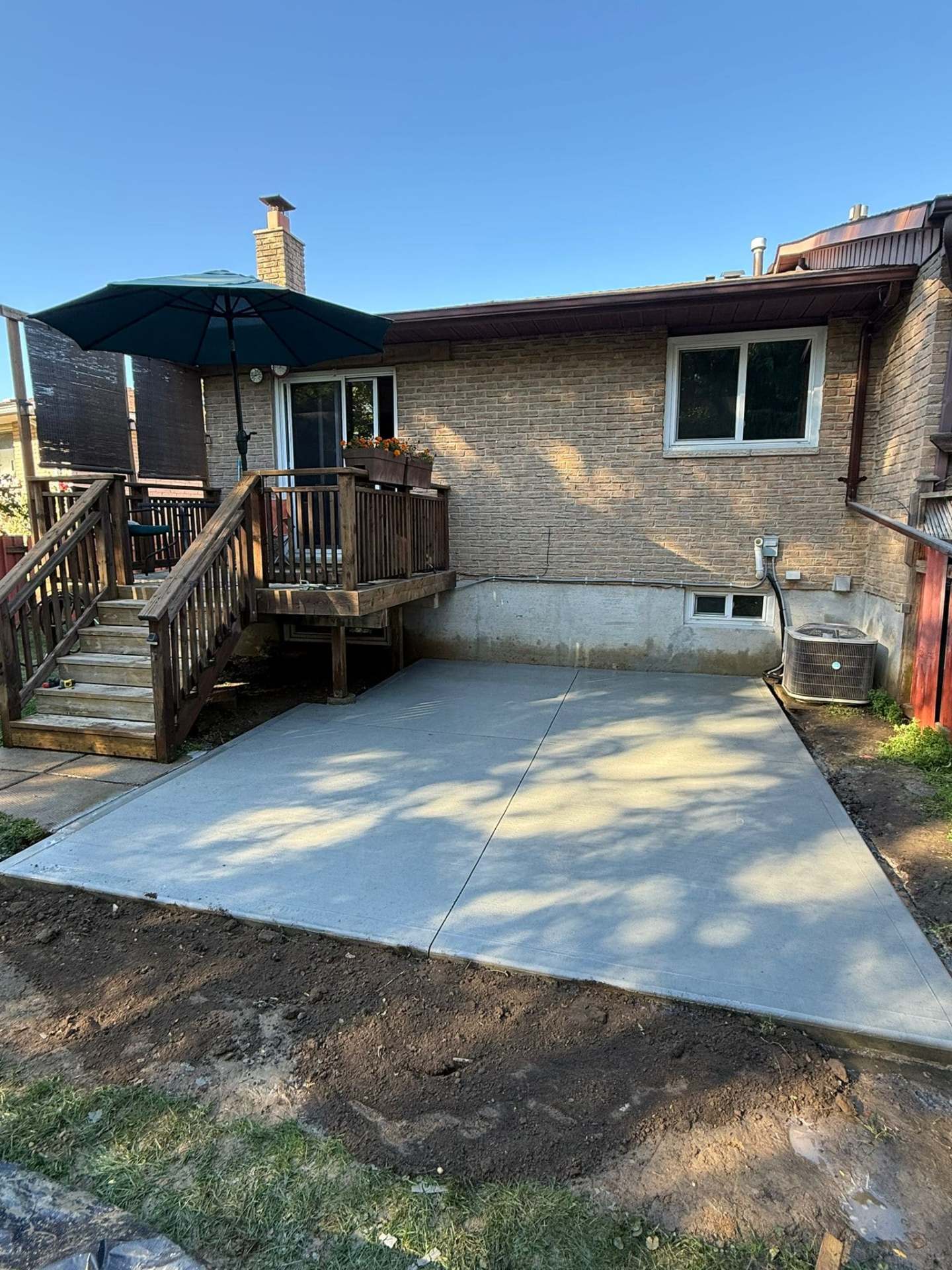


What a concrete driveway from us includes
Your written quote carries each of these lines, so the price you compare is for the same driveway.
- Excavation and disposal: The old asphalt or concrete is broken out and the soil and sod beneath removed as necessary. Old concrete is loaded, hauled and tipped at a licensed disposal site.
- A 4 inch compacted aggregate base: Compacted so the slab has something solid under it everywhere, including at the edges, where most driveways are starved of base.
- 10 gauge wire mesh throughout: Reinforcement across the whole slab, lifted into the pour rather than left lying on the base where it does nothing.
- 32 MPa concrete, 4 inches or more thick: The strength class for Canadian flatwork exposed to salt and frost, poured at a thickness that carries a car, with a brush finish for grip.
- Formed to the shape you want: A flare at the street, a step at the garage, a pad beside the house for a second car, a curve around a garden.
- Stress joints, stripped forms and a clean slab: Joints cut to control where the concrete cracks, so it cracks in the joint and not across the apron.
- The edges put back: Soil placed along the edges where the form boards were, so there are no gaps or trenches left behind for the lawn mower to find.
Google reviews
What our customers say
“The crew at Lumen Landscaping did an amazing job pouring our concrete patio last September. The entire experience was positive from beginning to end. The owner was honest, professional, and clearly takes great pride in his work.”
“We recently hired Lumen Landscaping to build a stone patio in our backyard, a concrete pad for our shed. … The owner is professional and highly knowledgeable, providing great advice and solutions for a reasonable price.”
“They built a concrete slab for our new backyard shed and also cleaned up a side garden area that needed a refresh. … Prices are reasonable and results are great. He's our go to person for outdoor landscaping work.”
Step by step
How the pour goes, step by step
A driveway is a one day pour with a week of work around it. This is the order.
- The visit and the written quote: We measure, check the fall from the garage to the street, look at where the apron meets the City sidewalk, and send a written quote with the specification above on it.
- Locates and the boulevard: Ontario One Call marks the buried gas, hydro and telecom lines; it is free and takes about five business days. A new or wider approach across the City boulevard needs Hamilton's driveway access approval, with single approaches 2.7 to 3.6 m wide and double 5.4 to 6.1 m. We tell you before we quote whether yours does.
- Breakout and haul: The old driveway comes out and goes to a licensed disposal site. We dig to the depth the base and the slab need together.
- Base, forms and mesh: Four inches of aggregate compacted, forms set to the finished height and slope, mesh laid throughout.
- The pour and the finish: 32 MPa concrete placed, screeded and floated, then brush finished for grip. The crew stays with it until it is finished, not until the truck leaves.
- Joints, cure and the first week: Stress joints cut on time, forms stripped, the slab cleaned and the edges backfilled. Keep cars off for at least seven days, the Ontario ready mixed concrete industry's own guidance. We tell you the date.
Built for winter
Why concrete lasts in Hamilton, and how we build for it
A Hamilton driveway lives a hard life. Lake air keeps the winters swinging above and below freezing, sometimes several times in a week, so water in the slab freezes, expands, thaws and freezes again. Road salt comes home on the tires. Spring melt soaks the ground under the driveway for weeks. A driveway that is poured for that climate shrugs it off for decades; one that is poured for a sunny day scales and cracks within a few winters. The difference is all in the build.
The concrete itself
The 32 MPa mix we use is the strength Canadian standards call for in flatwork exposed to freezing, thawing and de-icing salt, exposure class C-2 under CSA A23.1. Concrete in that class is air entrained: it holds millions of tiny air pockets that give freezing water somewhere to expand, so the surface does not pop. It is the same class the City specifies for sidewalks and driveway entrances, and it is the first line of defence against scaling.
The base, and the water under it
Most driveway failures start underneath. Water that sits under a slab turns to ice and lifts it, then drops it when it thaws; after a few cycles a corner sits low and a crack runs across the apron. Our four inch compacted aggregate base drains, and it is compacted to the same depth at the edges as in the middle, where thin bases usually starve. The subgrade is shaped so the slab falls toward the street, and if the yard sends water at the driveway, we deal with that first; see yard drainage.
Joints and mesh: deciding where it cracks
All concrete shrinks a little as it cures, so every slab cracks somewhere. The job is to choose where. Stress joints cut on time, at the right depth and in a sensible grid, give the slab a straight line to crack in, hidden inside the joint. The 10 gauge wire mesh lifted into the pour holds the two sides of any crack together so nothing moves or lips. A slab with no mesh and joints cut late cracks wherever it likes, and those wandering cracks collect water and salt.
The finish, the cure and the first month
A brush finish gives grip in winter and leaves a dense surface. Overworking the surface draws water and cement paste to the top and leaves a weak skin that salt eats; our crew stays with the slab until it is finished, not until the truck leaves. Then the concrete needs time: no vehicles for at least seven days, and at least thirty days of air drying before it is sealed. A breathable sealer applied then slows the water and salt getting in, and it is well worth doing before the first winter.
The edges and the downspouts
Damage starts where things meet. The apron should shed water away from the garage door, garden beds should not sit higher than the slab, and no downspout should empty onto the driveway or across the front walk. Where there is nowhere else for the water to go, a narrow channel drain at the garage catches it before it crosses the threshold and freezes. Those small details are what keep a driveway free of ice in January and free of ponding in April.
Winter care that actually works
Clear snow early, before it packs and melts into the slab. Use sand for grip in the first winter and no de-icer of any kind. After the first year, light applications of plain rock salt are fine; calcium chloride, magnesium chloride and anything with ammonium in it attack the surface and are never a good idea. Every spring, walk the driveway: check that water still runs off, that no joint has opened, and that the edges have not settled. A small repair in May is cheaper than a big one in November. Our guide to preventing concrete cracking in Ontario winters has the full routine.
Repair or replace?
Not every tired driveway needs to come out. A settled section, a broken apron or an open joint can often be repaired on its own, and a flaking porch or step can be resurfaced rather than rebuilt; see concrete porch and step repair. When the base has failed across the slab, or the cracks are wide and the panels sit at different heights, a new pour on a proper base is the better investment, and we will tell you which it is.

Why Hamilton homeowners choose Lumen for concrete
We are a local Hamilton company that runs your driveway from the dig to the finished slab, so one company answers for the base and the surface. You get a fast reply, a written quote with the specification on it, and the same team from the first call to the final clean.
- Materials at cost, no markup: You pay what the concrete, aggregate and mesh cost us; the contractor discount is passed straight to you.
- 1-year craftsmanship warranty: If something we built moves or fails within a year because of how we built it, we come back and make it right.
- Fully insured: Liability coverage on every job, so your home is protected while we work.
- Over 40 five-star Google reviews: Local homeowners rate us five stars, and you can read every review on Google.

Planning
What is not included, what changes the price, and the first winter
Not included. Any City fee for a new or wider approach is yours. Sealing is not in the base scope, though we recommend it. Stamped, exposed aggregate and coloured finishes are quoted separately on our concrete page. Steps, a porch or a shed pad poured with the driveway are quoted on their own lines; see concrete steps, porches and pads.
What affects the price.
- The size of the driveway and how thick the old slab is
- The shape: a flare, a curve or a second pad adds forming
- Whether the truck can reach the forms or the concrete has to be pumped or wheeled
- The fall from the garage to the street, and any drainage work at the low spot
- How much soil has to leave to make room for the base
The first winter. New concrete is most vulnerable in its first year, while it is still drying out. Concrete Ontario’s guidance is plain: no de-icer of any type in the first winter, sand for grip instead, and keep snow and ice from building up on the slab. Seal the driveway after at least 30 days of air drying. After the first year, light applications of plain rock salt are fine; calcium chloride, magnesium chloride and any ammonium product attack the surface and are never a good idea. Read our guide, how to prevent concrete cracking in Ontario winters.
The season. Concrete needs warm enough ground and air to cure, so concrete season runs from spring to fall. A driveway is a one day pour with the breakout a few days before; your quote gives the dates.
Service Areas
Where we build concrete driveways
Hamilton is home: Hamilton (see our Hamilton concrete page), Ancaster, Dundas, Stoney Creek, Waterdown, Mount Hope, Binbrook and Glanbrook and Flamborough. We also build them in Burlington (Burlington concrete), Grimsby, Oakville, Mississauga, Cambridge and Guelph, wherever the work is. On a Mountain or Binbrook lot the clay under the driveway holds water, so the base and the fall to the street get extra attention. See all our service areas.
From the blog
Helpful guides
Related
Problems this fixes, and related pages
If something is wrong with the driveway you have, read cracked or sunken concrete and ice on the walkway every winter. Related: concrete patios, finishes and repairs, interlock driveways, stamped concrete and concrete steps, porches and pads.
FAQs
Concrete driveway questions
We install 4 inches or more of 32 MPa concrete over a 4 inch compacted aggregate base with 10 gauge wire mesh throughout. The thickness carries the car; the base and the mesh are what keep it from cracking and settling. A thinner pour on a thin base is cheaper on the day and costs more within a few winters.
All concrete shrinks a little as it cures, so it will crack somewhere. The job is to decide where: stress joints cut on time give it a straight line to crack in, hidden in the joint. Cracks that wander across a slab come from a poor base, no mesh or joints cut late. A properly built driveway shows hairline lines in the joints and nothing else.
No. We dig out enough soil for the base and the slab together, so the finished driveway sits below the garage slab, the basement windows, the vents and the weep holes, and falls away from the house toward the street. Where an old driveway has been built up over the years, we tell you at the quote what has to come out to get there; read before the pour: slope, vents and clearances.
Scaling comes from water and salt getting into a weak surface: a mix without air entrainment, a surface overworked while finishing, or de-icer used in the first winter before the slab had dried. We use the C-2 class mix the standard calls for, brush finish it without overworking it, and tell you to keep de-icer off it for the first year.
Not in the first winter. Concrete Ontario recommends no de-icer of any type in the first year, with sand for traction instead. After that, light applications of plain rock salt are fine. Never use calcium chloride, magnesium chloride or anything with ammonium in it; they attack the surface.
Yes. Let the slab air dry for at least thirty days, then apply a breathable concrete sealer before the first winter. It slows water and salt getting in, which is what causes scaling. Sealing is not in the base scope, but we recommend it and can quote it with the driveway.
Keep vehicles off for at least seven days, which is the Ontario concrete industry's guidance. You can walk on it the next day. We give you the exact date before we leave.
The pour itself is one day, with the breakout and the base a few days before it, so a driveway is about a week of work from start to finish. Then keep cars off for at least seven days while it cures, and your written quote gives the dates. If rain moves the pour, we try to give a heads-up on any delays and let you know when we are coming, with as much notice as possible.
Yes. We break out the old asphalt or concrete, haul it away and tip it at a licensed disposal site, and the quote shows that as its own line so you can see what the removal costs.
Often, yes. A settled panel, a broken apron or an open joint can be repaired on its own when the base under the rest of the driveway is sound. We look at the whole slab before we recommend either, and we quote the repair and the replacement as separate options when both make sense.
Yes. This page is the plain broom finish driveway, and stamped, exposed aggregate and coloured finishes are quoted on their own; our stamped concrete page shows the patterns. Broom finish is the simple, grippy standard, exposed aggregate shows the stone in the mix and hides dirt, and stamped copies stone or brick and is best sealed to keep its colour.
Concrete suits a simple driveway at a lower price. Interlock costs more, comes in far more looks and can be repaired one section at a time. We build both and will tell you which fits your home. See interlock driveways.
On your own lot, how wide a driveway can be is set by your zoning. Building or widening the part that crosses the City boulevard needs the City of Hamilton's driveway access approval, with single approaches 2.7 to 3.6 m wide and double 5.4 to 6.1 m, and the City builds that approach itself; applications sent after August 1 are generally built the next season. We tell you before we quote whether your plan needs the approval, and the driveway on your side is built to meet it.
How it works
Getting started is easy
- 1
Call or send the form
Tell us what you have in mind. We reply fast, usually within the hour.
- 2
Get your free quote
We look at your project and send you a clear, written quote quickly.
- 3
We build it
We start quickly and back our craftsmanship with a 1-year warranty.
Get Free Quote
Get a Free Concrete Driveway Quote
Tell us about your driveway and what is on it now. We will measure, check the apron and get back to you fast with a free written quote that spells out the base, the mesh and the pour.