

The Patio Around My Pool Is Sinking and Shifting
A dip beside the skimmer, coping that has pulled away from the pavers, a corner by the equipment pad that drops a little more each spring. The ground around a pool was dug and refilled, and refilled ground settles. It can be lifted and set right. Lumen Landscaping lifts and resets sunken pool patios across Hamilton: call (905) 906-0671 or send the form for a free written quote.
- Fully insured
- 1-year craftsmanship warranty
- Hamilton owned and operated
Quick to quote, quick to start, we answer every call.
Serving Hamilton, Burlington, Oakville and the wider region, from Guelph to Niagara.
Get your fast, free quote
We reply fast, usually within the hour.
The problem
What you are seeing
The pavers right beside the pool have dropped below the coping, so there is a lip where there used to be a flush edge. Along one side there is a dip that holds water after every swim. The slabs by the equipment pad tilt, the joints have opened, and a few pavers near the steps rock when you stand on them wet. In the far corner the whole patio seems to be sliding gently toward the fence.
A pool patio has a problem that no other patio has. When the pool went in, a hole much bigger than the shell was dug, the shell was set, and the gap between the shell and the hole was filled back in. That ring of refilled ground is almost impossible to compact properly, because heavy compaction equipment right against a pool wall risks the wall, so it goes in loose and settles for years. The patio sits on it. The coping sits on the pool wall and does not move. The gap between the two is the ring of sinking you are looking at.
Add water, and the ring settles faster. Splash, backwash, a yard that drains toward the pool, and sometimes a leaking line all wash the fine material out of the base. The fix is to rebuild the base in that ring so it stops moving, and to make sure the water leaves.
Our Work
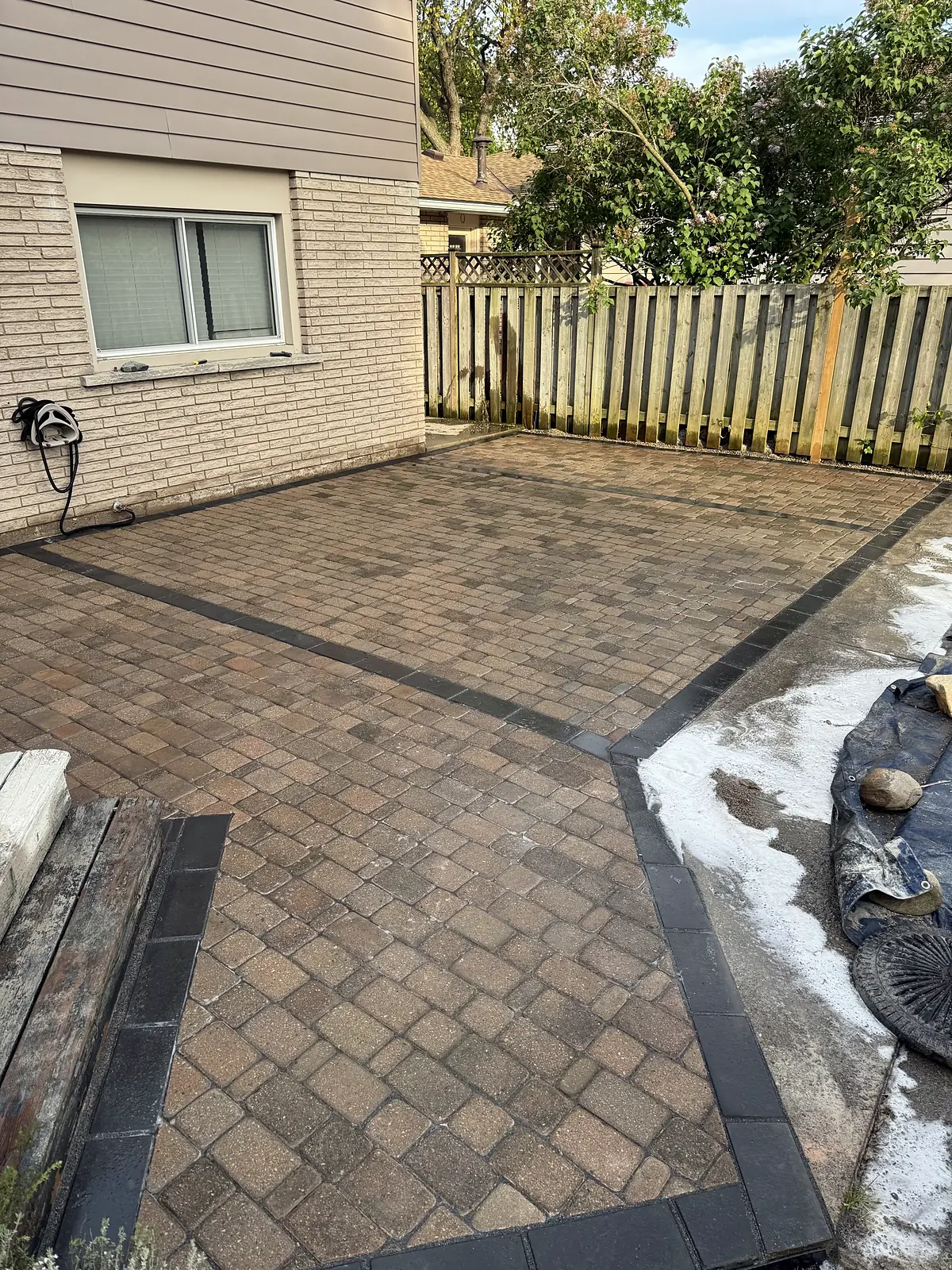
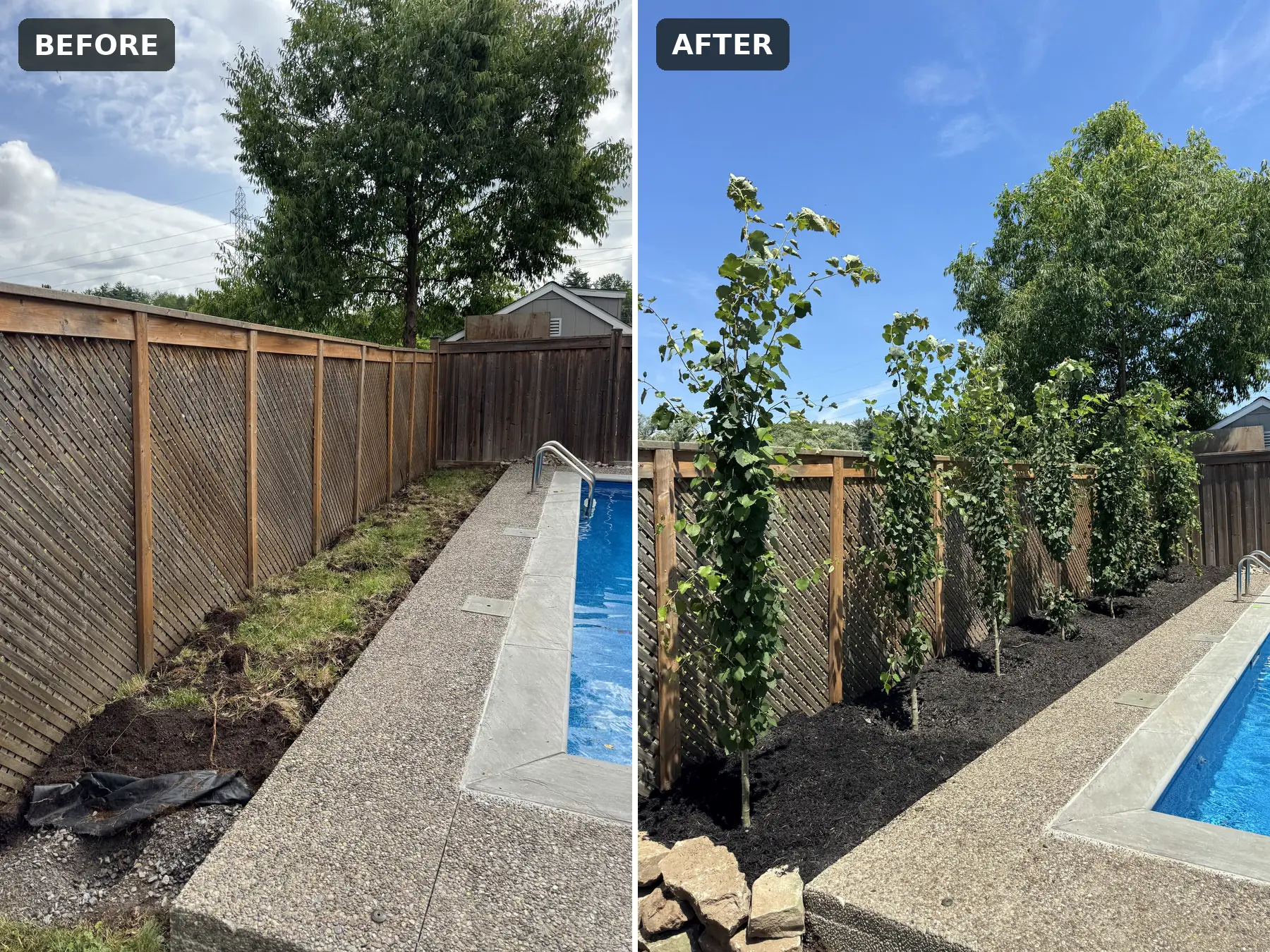
Pool patios and pool yards we have worked on


Why pool patios sink and shift
The ring around the shell is the usual story, but it is rarely the only one.
- The backfill ring: The ground around the shell was dug out and refilled, and refilled ground settles. Compaction equipment cannot be used hard against a pool wall, so the ring goes in looser than the rest of the yard.
- Two structures, one patio: The coping sits on the pool wall, which sits on its own footing and does not move. The pavers beside it sit on the backfill, which does. Every spring the gap between them shows how much the ring moved over the winter.
- Water from the pool: Splash, backwash and the hose that fills the pool all land on the same ring of pavers. Water carries the fine material out of the base and leaves voids for the pavers to drop into.
- Water from the yard: A pool patio that was set level, or that the lawn drains toward, keeps the base wet. The patio should fall gently away from the pool, so rain and splash leave instead of soaking in beside the shell.
- A leaking line: A return line or a skimmer line with a slow leak washes out the base under one spot. A dip that is in one place, keeps growing and never dries is worth having the pool company check before anything is lifted.
- Clay: Much of Hamilton sits on clay, which swells when wet and heaves when frozen. Around a pool, where the ground is wetter than anywhere else in the yard, it moves the most.
Google reviews
What our customers say
“We had a gravel walkway around our pool and equipment that had become overgrown with weeds, and grasses. The crew removed all the existing weeds etc., stone, and fabric. … We are very pleased with their work. They delivered as promised.”
“My front walk and back patio needed maintenance due to misaligned stones and weeds. … I am very happy with the result and greatly appreciate the owner's planting suggestions for the low maintenance gardens I require.”
“They returned my call the same day I phoned. He arranged a visit and gave me a few options to repair my stone stairs. He did the work within 2 weeks and did a great job. I highly recommend him.”
The fix
How we fix a sinking pool patio
We lift the pavers in the sunken ring and set them aside in order, leaving the coping alone, because the coping sits on the pool wall and is not ours to disturb. Then we open the base to see how deep it is and how wet. We dig out the soft material, add gravel and compact it in thin layers, working carefully near the shell, re-screed the bedding so the patio falls gently away from the pool, and reset the same pavers flush with the coping and with each other. Joints are filled with polymeric sand in two applications, and we pressure wash the whole patio so the repaired ring matches the rest. That is our patio restoration service, the same work we do on a sinking interlock patio anywhere else in the yard, with more care taken around the shell and the lines.
When the whole deck has moved, or the pavers were laid on sand straight over the backfill, we quote a rebuild on a proper base through our interlock service. And if a dip looks like a leak, we say so and ask you to have the pool company check the lines first, because re-levelling over a leak is a repair done twice.
The rules around a pool are worth knowing. Hamilton's grading review for pools asks that the existing drainage patterns on the lot stay as they were, that swales along the property lines are not obstructed or moved, and that grade changes stay small. In Burlington, the site alteration by-law regulates fill and grade changes, and its screening form asks about work within half a metre of a lot line and about retaining walls. We work within both. On the lakeshore in Stoney Creek, where the bigger backyards have pools and the ground is near the creeks and the lake, the water side of the job matters most.

Check this yourself first
A pool patio tells you a lot in the hour after a swim and the hour after a rain.
- Map the low spots: Walk the whole patio and mark where the pavers have dropped. A dip that runs in a ring near the shell is the backfill settling. A single spot that keeps growing points at water, and possibly a leak.
- Watch it after a rain: Note where water sits and which way it runs. Water that stays against the coping or runs toward the pool is feeding the ring. Water that runs away and leaves is what you want.
- Check the coping joint: Look at where the pavers meet the coping. A gap or a lip there is the gap between the pool wall, which does not move, and the patio, which has. The coping itself is almost never the problem.
- Look at the equipment pad and the lines: The pad and the trench the lines run in were dug and refilled too. A tilt at the pad, or a dip that follows a straight line from the pool to the pad, is settling along that trench.
- When to call: A lip at the coping that catches a toe, pavers that rock when wet, or a dip that holds water beside the pool is worth fixing before the season, when the patio is in use every day. Call (905) 906-0671 and we will take a look.

Planning
What a lasting repair includes, and what changes the price
A lasting repair always includes
- Finding the cause: settling in the ring, water from the yard, or a leak, before anything is lifted
- The coping left in place and the pavers reset flush to it
- Soft base dug out, gravel added and compacted in thin layers near the shell
- Bedding re-screeded so the patio falls away from the pool
- Polymeric sand in two applications and a full wash
- Downspouts and lawn edges sorted so the yard stops draining toward the pool
What affects the price
- How much of the patio has moved: the ring beside the shell or the whole deck
- Whether the pavers or slabs can be reused
- How much base has to be dug out and rebuilt
- Drainage work beside the pool, and whether the equipment pad is reset too
- Access to the backyard for gravel and the compactor
- Sealing, if you want the whole deck sealed while it is clean
A typical repair, in plain words. Picture a paver pool deck with a dip along the deep end and a lip at the coping by the steps. We lift two courses along that side, rebuild and compact the base, reset the pavers with a fall away from the water, re-sand and wash everything. The deck is flush with the coping again and the puddle after a swim is gone. A pool patio in Burlington with a lawn that drains toward it gets the same work plus a regraded edge, so the ring stops refilling with water every storm. One of our reviews mentions the care taken working around a pool when we re-sodded a backyard, and the same care goes into every pool deck.
Every quote is written and free, and materials are billed at what they cost us with no markup.
Related
Related pages
Services: patio restoration and interlock patios. Related problems: a sinking interlock patio and faded, stained or mossy patio stones. Areas: Stoney Creek, Burlington and Hamilton. More answers on our FAQ page, and more problems we fix.
FAQs
Pool patio questions
Because the ground beside the shell was dug out and refilled when the pool went in, and compaction equipment cannot be used hard against a pool wall, so that ring goes in loose and settles for years. The coping on the pool wall stays put, which is why the gap shows there.
No, and we do not. The coping sits on the pool wall and belongs to the pool. We lift the pavers beside it, rebuild the base and reset them flush to the coping. If the coping itself is loose, that is a pool company's job and we will tell you.
It could, if the dip is in one spot, keeps growing and never dries. A return or skimmer line with a slow leak washes out the base under it. We tell you when a dip looks like that and ask you to have the lines checked first, because re-levelling over a leak gets done twice.
Not if the base in the ring is rebuilt and compacted properly and the water is made to leave. We re-screed the deck so it falls away from the pool, sort the downspouts and the lawn edge, and back the work with a 1-year craftsmanship warranty.
Yes. Hamilton's grading review for pools asks that existing drainage patterns stay as they were, that swales along property lines are not obstructed or moved, and that grade changes stay small. Burlington regulates fill and grade changes under its site alteration by-law. We work within them and tell you if a plan would not.
Spring and fall are ideal, when the deck is not in daily use and the ground is not frozen. Polymeric sand needs dry, mild weather to set, so we pick the days around the forecast. Book before the season and the deck is ready for the first swim.
How it works
Getting started is easy
- 1
Call or send the form
Tell us what you have in mind. We reply fast, usually within the hour.
- 2
Get your free quote
We look at your project and send you a clear, written quote quickly.
- 3
We build it
We start quickly and back our craftsmanship with a 1-year warranty.
Get Free Quote
Get a Free Quote to Fix Your Pool Patio
Tell us where the pavers have dropped and whether the dip is beside the pool or somewhere else. We will take a look, tell you what is going on underneath, and get back to you fast with a free written quote.