
Choosing Paver Colours and Patterns That Match Your Brick
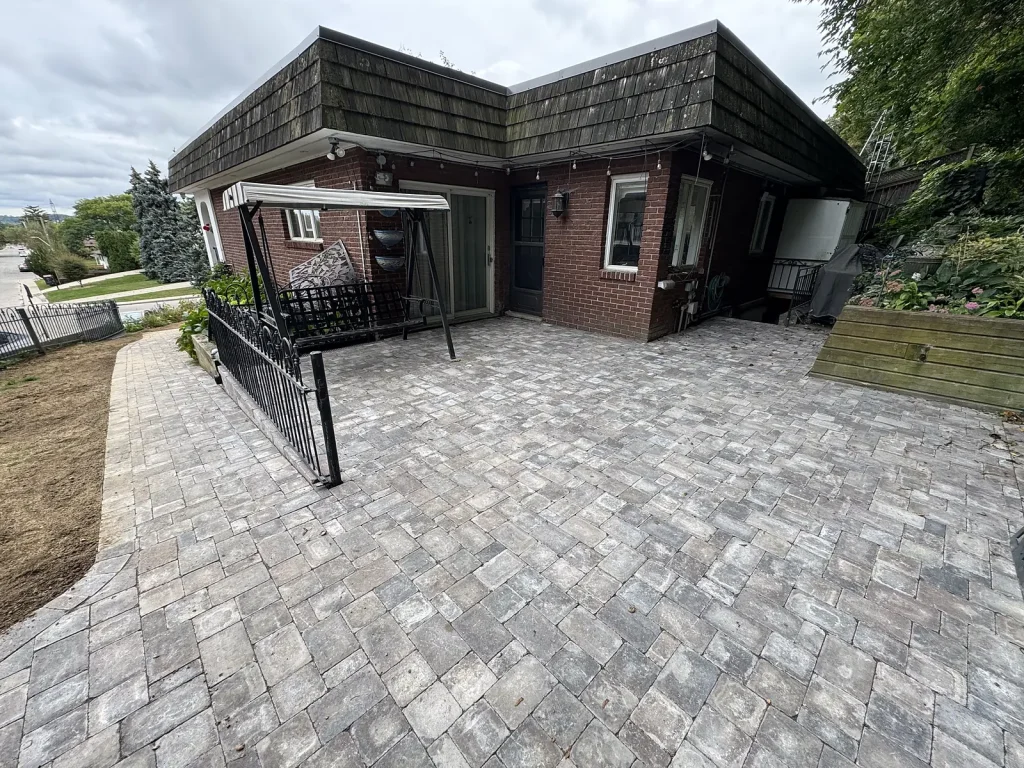
The easiest way to match pavers to your brick is not to match them at all: pick a paver a few shades lighter or darker than the brick, in the same warm or cool family, so the two read as a pair rather than a near miss. Then let the pattern and a single border do the work of making it look designed.
We install any brand you like for interlock patios, driveways and walkways in Hamilton: Unilock, Techo-Bloc, Best Way Stone and Triple H, most of it from Hamilton Builders Supply, billed at what it costs us. That gives you hundreds of colours to choose from, which is exactly why a few rules help.
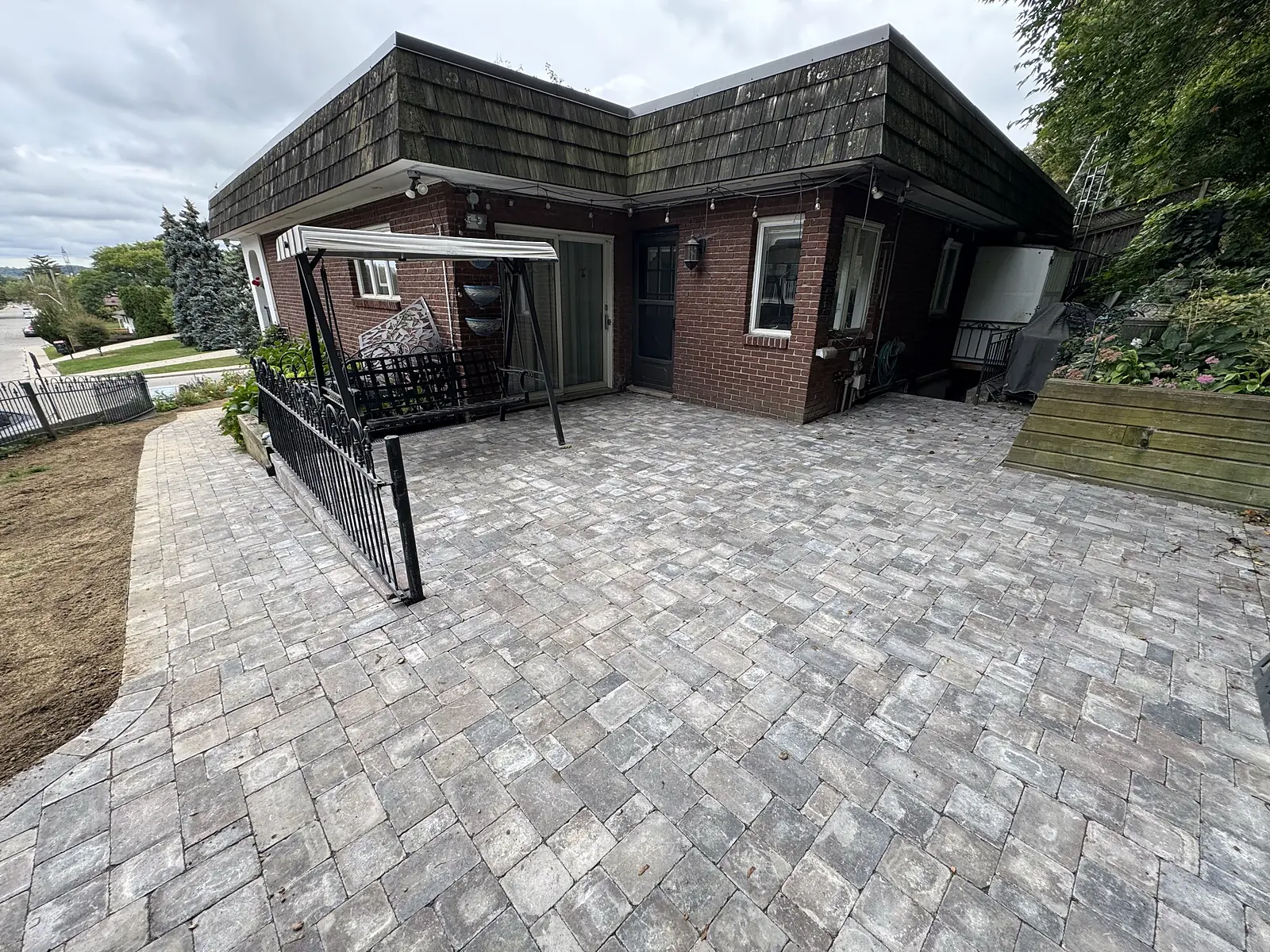
Start with the house, not the catalogue
Stand across the street and look at the three big colours: the brick or stone, the siding or stucco, and the trim, including the garage door and the front door. Decide which one you want the pavers to belong to. On the red brick homes of the lower city, a warm grey or a tan paver sits comfortably beside the brick and keeps the red from shouting. On the grey and brown brick of the newer builds in Binbrook and the upper Stoney Creek subdivisions, a charcoal or a mid grey with a little brown in it looks like it was always there.
Matching the brick exactly almost never works. Brick has a dozen tones in one wall, pavers have a blend of their own, and the two blends rarely line up. Side by side, an almost match looks like a mistake, while a deliberate contrast looks like a choice.
Warm or cool, then light or dark
Every paver colour leans warm (tan, beige, brown, rust) or cool (grey, charcoal, blue grey). Keep the pavers in the same family as the brick. Red, orange and buff brick is warm; grey, white and most modern brick is cool. Once you have the family, choose light or dark:
- Lighter pavers make a small patio or walkway feel bigger and stay cooler underfoot in July, but they show tire marks and leaf stains more.
- Darker pavers hide marks, salt residue and dirt on a driveway, and make a large area feel more grounded, but they hold heat.
- Blended pavers, with two or three tones in each stone, hide almost everything and are the safest choice for a driveway.
Patterns that hold up, and patterns that just look good
On a patio, the pattern is a style choice. On a driveway, it is a structural one. Pavers that interlock in a herringbone pattern spread the load of a turning tire across many stones and stay put; stones laid in straight rows can creep under the same load. Our rule of thumb:
- Herringbone for driveways and anywhere cars turn. It takes the most cuts along the edges, which a border hides.
- Running bond for patios and walkways: clean, simple, few cuts, and easy to match later if a stone ever needs replacing.
- Random or modular layouts, mixing two or three stone sizes, for patios where you want the look of natural stone without the price of it.
- Large format slabs for a modern patio with few joints, set on the same compacted base as any other paver.
Whatever the field, one border in a contrasting or darker tone frames the area, hides the cut edges and costs far less than a decorative inlay. Two borders, inlays and curves look lovely in a catalogue and add a great deal of cutting, which is where the labour on an interlock job goes.

Look at samples in your own light
A paver that looks perfect under the showroom lights looks different beside your brick at four in the afternoon. We bring sample stones to the house, wet one of them, and set them against the wall in the shade and in the sun. Wet pavers show you what the colour will be after a rain and after sealing, which is when most people decide they wish they had gone a shade lighter. Our guide to choosing an interlock sealer covers how sealing changes the colour.
Matching an existing patio or walkway
If you are extending a patio or replacing a sunken section, bring us a loose stone or a close photo. Many pavers from the last twenty years are still made, and where a colour has been discontinued we can usually find the current version of it, or set the new area off with a border so the join is deliberate. Weathered pavers can be pressure washed and re-sanded at the same time so old and new sit closer in tone; see patio and interlock restoration.
A simple way to decide
- Name the colour family of your brick: warm or cool.
- Pick a blended paver in that family, a shade or two away from the brick.
- Choose herringbone for a driveway, running bond or a modular layout for a patio.
- Add one border in a darker tone.
- See the samples wet, in your light, before you order.
Frequently asked questions
Can I bring my own paver choice?
Yes. Pick any brand and colour you like and we will install it. If something about the choice will cause a problem, such as a patio paver on a driveway, we will say so before we order.
Do you charge more for one brand than another?
Only what the supplier charges. The stone is billed at cost, with the contractor discount passed to you, so the price difference between brands is the supplier’s, not ours.
Do you do designs?
Designs are available on request. For most patios, a sample stone against the wall and a chalk line on the grass tells you more than a drawing.
Bring us a photo of your house
Send a photo of the front or back of the house and the area you want to pave, and we will suggest two or three paver colours to start with. Call (905) 906-0671 or use the form on our contact page. Quick to quote, quick to start, and we answer every call.
