
Planting a Cedar Hedge

A cedar hedge is planted in a single trench, with the trees set at the same depth they grew in the pot, spaced so they touch within two or three seasons, backfilled with good soil, mulched, and watered deeply through the first two summers. Get those five things right and the hedge fills in and stays green; miss the watering and it browns from the bottom in its first August.
Cedars are the privacy plant for Hamilton yards, from the long lot lines of Stoney Creek to the narrow side yards downtown, and planting them is a regular part of our garden installation work in Hamilton. Here is how we do it, and how to look after it after we leave.
Choosing the cedar
Most hedges here are Eastern white cedar or one of its selections. Emerald cedar is the usual choice: narrow, dense, bright green, and slow enough to stay tidy at a trimmed height of six to eight feet. Plain white cedar grows faster and wider and suits a long rural lot line where you want a wall quickly and have room for it. Black cedar sits between the two and holds its colour well in winter. Bigger pots give you privacy sooner; smaller pots cost less, settle in faster, and catch up within a few years. We plant by pot size and bill the trees at what they cost us at the nursery.
Spacing
Space the trees so they meet in two or three seasons without crowding each other out. As a rule:
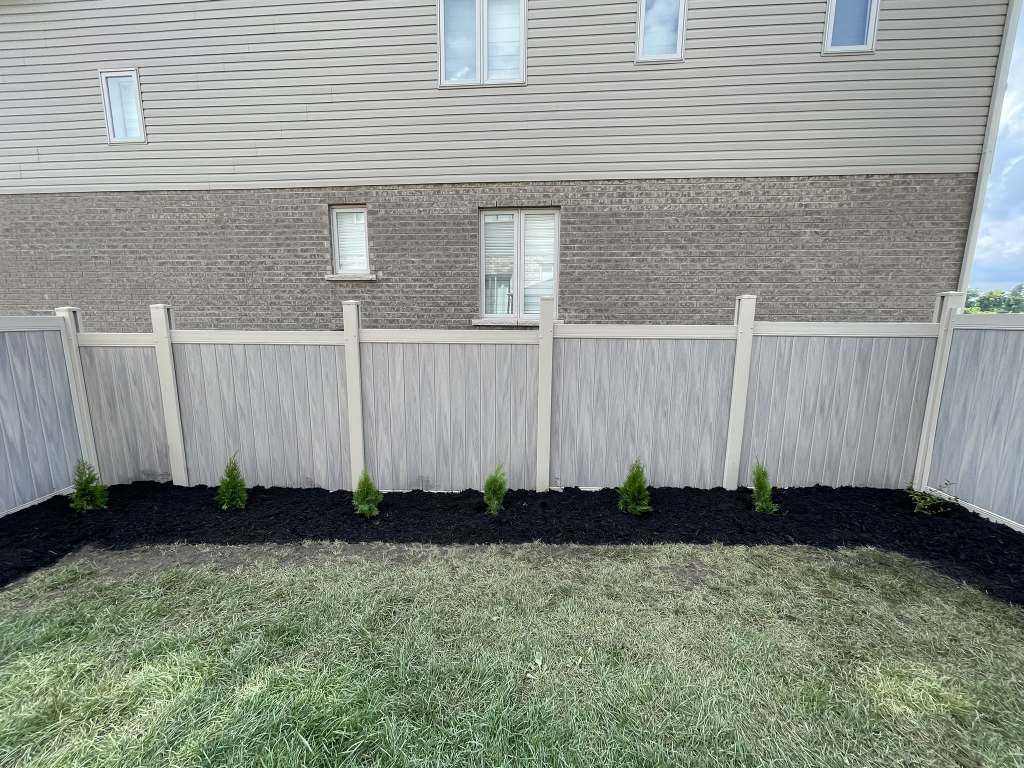
- Emerald cedars in small pots: about two feet apart, trunk to trunk.
- Emerald cedars in larger pots, five feet tall and up: about two and a half to three feet apart.
- White or black cedar, which grow wider: three to four feet apart.
Closer than that and the trees compete, lose their lower branches and thin out at the base. Wider and you wait years for the gaps to close. Keep the row at least two feet off the fence or the property line, or the hedge grows into it and the neighbour trims your trees.
Planting it
- Set out the line with a string, dead straight or on the curve you want. A hedge shows every wobble.
- Dig one trench the length of the row, as deep as the pots and twice as wide, rather than a hole per tree. Roots spread sideways into loosened soil.
- Loosen the bottom and sides of the trench. On clay, which most of Stoney Creek and the Mountain sits on, break the hard pan so water does not sit under the roots.
- Set each tree at the depth it grew in the pot, no deeper. Tease out any circling roots.
- Backfill with the soil from the trench mixed with compost or new topsoil, firmed around each root ball, with no air pockets.
- Water each tree in slowly until the trench is soaked.
- Mulch the whole row two to three inches deep, kept off the trunks.
Spring and early fall are the best times to plant. Mid summer planting works if the watering is kept up; late fall planting leaves little time for roots before the freeze.
The first two summers
This is where cedar hedges live or die. A new cedar has a root ball the size of its pot and a top that loses water all day. For the first two summers, water deeply once or twice a week, more in a heat wave, so the soil is wet to the bottom of the root ball. A soaker hose along the row under the mulch does it with no effort. Sprinkling the foliage does nothing. Brown tips in August mean the roots went dry; a brown tree by September usually cannot be saved.
Going into winter, water well in late fall until the ground freezes. Cedars lose water through their foliage all winter and go into it needing a full tank. Burlap on the windward side helps a young hedge on an exposed lot; after a few years it is not needed.
Trimming
Leave the hedge alone for its first year except to snip a stray leader. From the second year, trim lightly once a year in early summer, after the spring flush has hardened, taking the sides back so the hedge is slightly narrower at the top than at the bottom, which keeps the lower branches in light. Set the height you want and hold it there; a cedar cut back into bare wood does not regrow from it. Our guide to when to trim shrubs and trees in Hamilton covers the timing for everything else in the yard.
Where cedars do not work
Deep shade, where they thin and lean toward the light. Standing water, where the roots rot. Right beside a salted driveway or road, where the spray browns them every spring. In those spots a fence with a vine, a row of yews, or a mixed shrub border does the job better, and we will say so.
Frequently asked questions
How far apart should cedars be planted for a hedge?
Roughly two to three feet apart for Emerald cedars, depending on pot size, and three to four feet for the wider white or black cedars. Closer makes a thin, leggy hedge; wider takes years to close.
How many do I need?
Measure the run and divide by the spacing. A fifty foot run of Emerald cedars at two and a half feet is about twenty trees. We confirm the count on the quote.
How thick should the mulch be?
Two to three inches over the whole row, pulled back from each trunk. More than that holds water against the stems and invites rot.
Get the hedge planted before the season ends
Measure the run, note the sun, and call (905) 906-0671 or send the form on our contact page. Many hedge quotes can be given by phone, text or email. We are quick to quote, quick to start, and we answer every call.
