
Replacing an Old Railway Tie or Wood Retaining Wall

An old railway tie or timber retaining wall is replaced by taking it out completely, ties, spikes, deadmen and all, and building a new wall in block or armour stone on a compacted clear gravel base with proper drainage behind it. Patching a rotten wood wall buys a year or two; replacing it buys decades.
Railway tie walls went into thousands of Burlington and Hamilton yards from the 1970s to the 1990s, and most of them are now past their life. This is how we handle one on a retaining wall job in Hamilton or Burlington: what goes wrong with the old wall, what the new one is built from, and what to expect on the day.
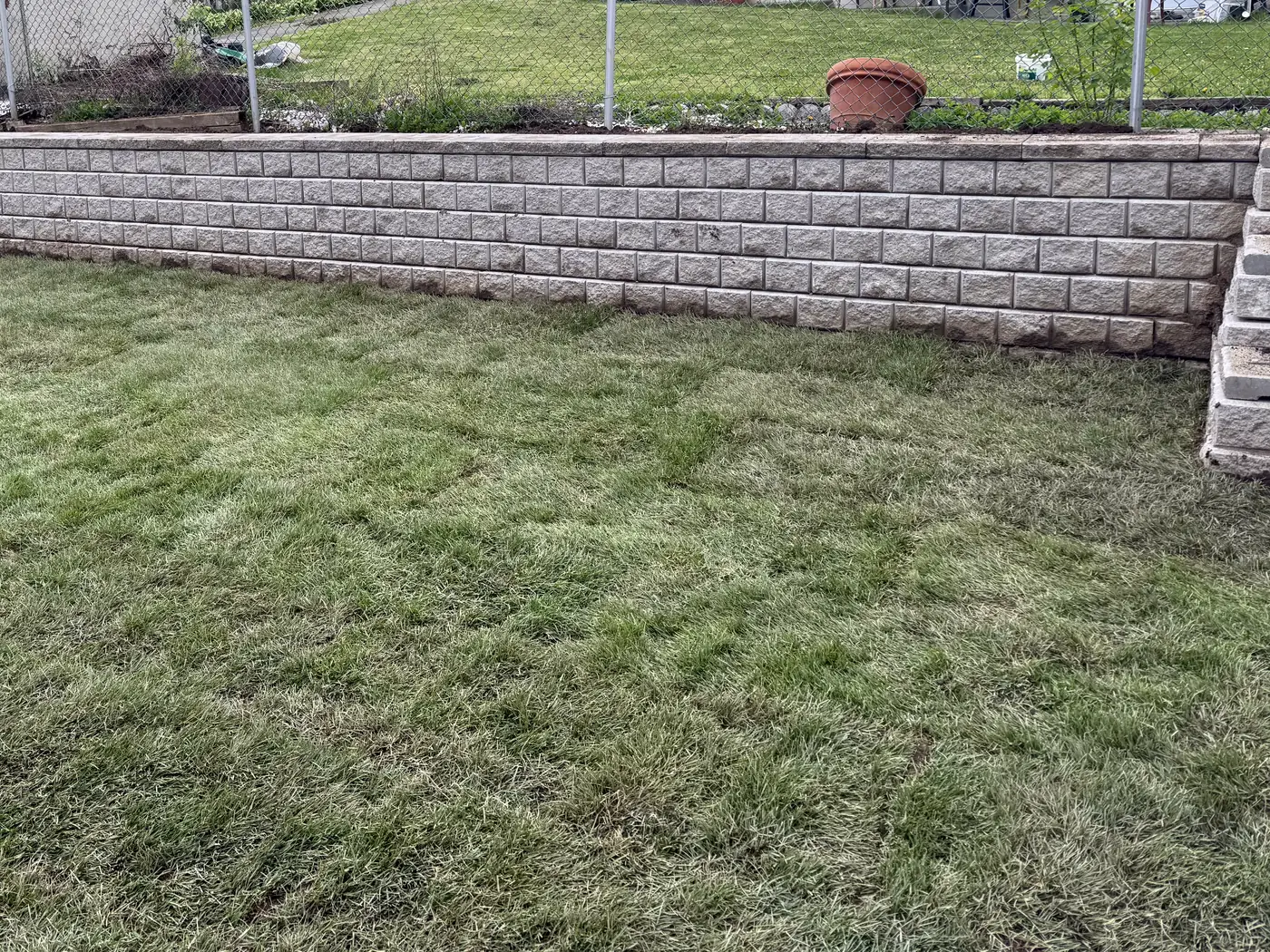
Why railway tie walls fail
Wood in contact with wet soil rots, and a retaining wall is wood pressed against wet soil on one side for its whole life. Railway ties were soaked in creosote, which slowed the rot but never stopped it, and the ties that were used in gardens were often the ones the railways had already retired. After twenty or thirty years:
- The bottom course is soft and the wall sags along its length.
- The deadmen, the ties buried back into the slope to anchor the wall, have rotted, so the wall leans forward.
- The spikes and rebar pins have rusted through and the ties have shifted out of line.
- Soil has washed through the gaps and the lawn above has sunk behind the wall.
- Carpenter ants have moved in, and the creosote smell comes back every hot afternoon.
Pressure treated timber walls built in the 1990s fail the same way, a little more slowly. Neither can be repaired in any lasting sense once the wood has gone soft.
What the new wall is built from
There are two good answers, and the choice is mostly about the look and the height.
Block
Segmental wall block, from any of the brands we install, comes in a range of colours and faces and builds a clean, straight wall with capped top. It handles curves and corners well, suits a garden wall and a terrace alike, and on a taller wall it is reinforced with geogrid laid back into the backfill every few courses so the whole slope holds the wall. Block is the usual replacement for a timber wall along a driveway or a front garden.
Armour stone
Large pieces of natural limestone set in a course or two, with the look of a quarry edge. Armour stone suits a backyard terrace, a slope down to a creek or a pool, and any yard with a natural feel. Each stone weighs hundreds of pounds, so access for the machine matters more. Our post on armour stone versus block compares the two in more detail.
How the replacement goes
- Take the old wall out. Ties are cut and pulled, the deadmen dug out of the slope, the spikes and pins collected, and all of it hauled away. Creosote ties cannot go in the regular waste, so they go to a site that takes them.
- Cut the slope back and dig the trench for the new base, below the old wall’s footing.
- Lay a compacted clear gravel base, level and true, so the first course sits right.
- Build the wall, with each course stepped back slightly into the slope. On a wall over about three feet, geogrid goes in between courses and is pulled tight into the backfill.
- Put the drainage in: filter fabric against the soil, clear stone behind the wall, and a perforated pipe along the base that runs out to daylight or to a drain. This is the part the old wall never had, and it is why the new one stays straight.
- Backfill in layers, compact, and set the caps on adhesive.
- Put the yard back: topsoil and sod above the wall, the garden bed in front, the edges tidied.
A typical front yard wall replacement takes a few days. We tell you the dates on the quote and give a heads-up on any weather delay with as much notice as we can.
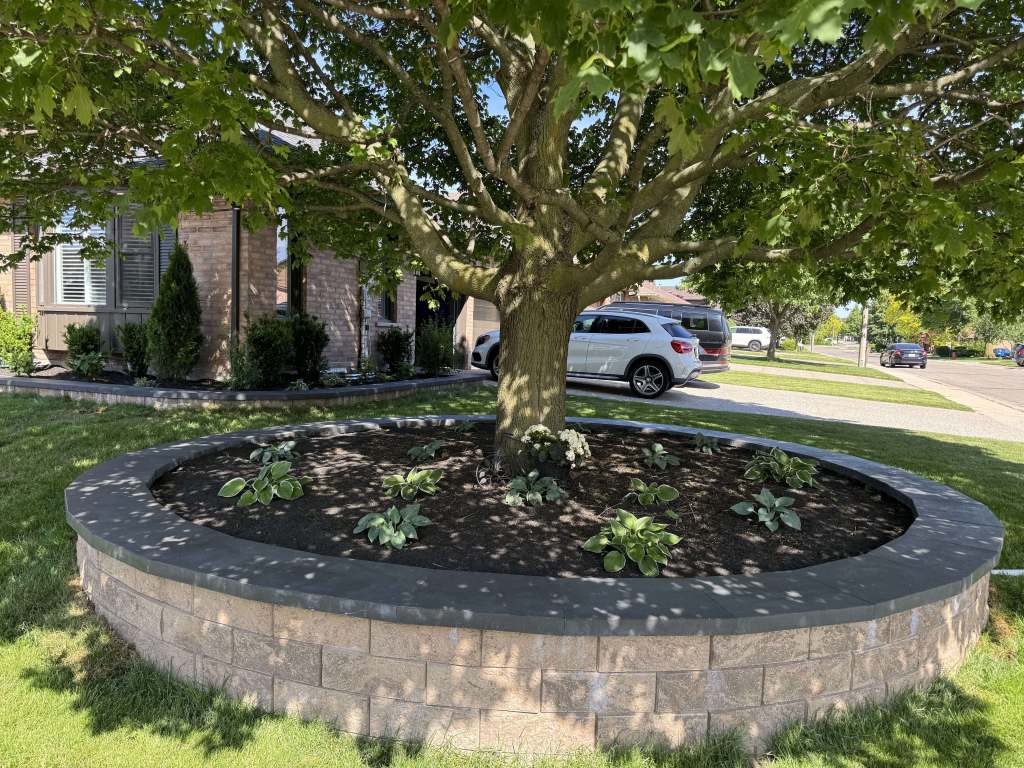
Things to decide before we quote
- Block or armour stone, and the colour. We bring samples.
- The height. The new wall can be the same height as the old one, or the slope can be reshaped so the wall is lower and the yard above is bigger.
- What is above the wall. If a fence, a shed or a driveway sits close behind it, the wall is designed for that load.
- Access. The old ties come out by hand; the new stone comes in by machine where it can.
Frequently asked questions
Can you just replace the rotten ties?
You can, but the next ties along are a year or two behind, and the drainage problem that rotted the first ones is still there. We will do a repair if that is what you want, and we will tell you honestly how long it is likely to last.
What goes behind the new wall?
Filter fabric, clear stone, a perforated drain pipe at the base, and geogrid reinforcement on taller walls. Water pressure is what pushes walls over, and the drainage is what lets the water out.
Do I need a permit?
Most garden and front yard walls do not. Taller walls, and walls near a property line or a slope, can; it depends on the height and the municipality. We tell you before we quote whether yours does.
Get a quote to replace your wall
Send a photo of the wall, front and back, with something in the shot for scale, and call (905) 906-0671 or use the form on our contact page. We are quick to quote, quick to start, and we answer every call.
