
Armour Stone vs Block Retaining Walls

Armour stone gives you a natural, heavy, one or two course wall that suits a backyard slope, a woodland edge or a pool surround; block gives you a clean, straight, capped wall in the colour you choose that suits a driveway, a front garden or a terrace with a patio on it. Underneath, both need the same compacted gravel base and the same drainage, and that is where most of the cost and all of the lifespan is.
Both are built every week as part of our retaining wall work in Hamilton. In Ancaster, where the older estates run to natural stone and the newer streets to crisp block, we often build both on the same property. Here is how to choose.
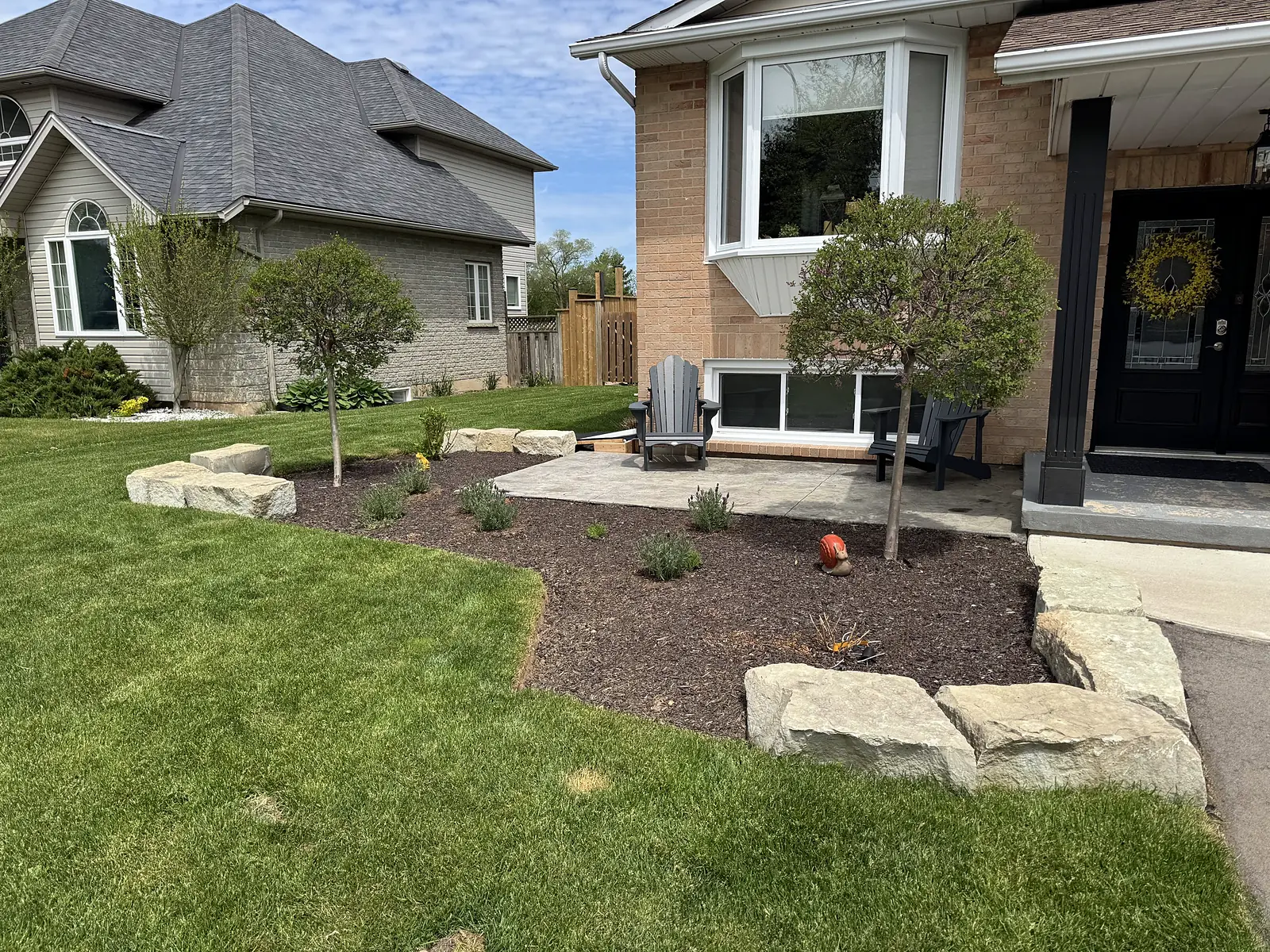
Armour stone
Armour stone is natural limestone, quarried in big slabs and blocks, typically a foot or two high and several feet long, each weighing hundreds of pounds. A wall is one or two courses of these stones set on a compacted base with a machine, fitted so the faces line up and the joints stay tight.
- The look: natural, solid, a little rugged. The face of each stone is different, and the wall reads as part of the landscape rather than a structure in it.
- Where it suits: backyard terraces, slopes down to a ravine or creek, pool surrounds, the edge of a woodland garden, and anywhere you want a broad flat top to sit on or plant behind.
- What to know: each stone is placed by machine, so the yard needs access for it. Curves are made of straight stones, so a tight curve is awkward. Walls over two courses are unusual; for height, block is the better tool. The top is uneven, which is part of the charm, but it is not a surface to build a patio against without a cut stone cap.
Block
Segmental retaining wall block is manufactured concrete, made to stack in courses that lock together, with a cap on top. It comes from the same brands as the pavers, Unilock, Techo-Bloc, Best Way Stone and Triple H, in a range of colours, textures and sizes, so it can match or complement a patio or a driveway.
- The look: clean and straight, or smoothly curved, with a finished top. Faces range from smooth to split to a tumbled, weathered style.
- Where it suits: driveway edges, front gardens, terraces with a patio on top, garden walls, and any wall that needs to be taller than a couple of feet. Block walls take geogrid reinforcement between courses, which is how a tall wall holds a slope.
- What to know: block builds by hand, so it goes where a machine cannot. Each course is stepped back slightly into the slope. The caps are set on adhesive. A block wall is only as good as its base and its drainage, exactly like any other.
What is the same for both
Everything you cannot see. A trench is dug below the old grade. A compacted clear gravel base goes in, level and true. Filter fabric lines the soil side so fines do not wash into the drainage. Clear stone goes behind the wall and a perforated pipe runs along the base, out to daylight or to a drain, so water never builds up behind the wall. The backfill goes in and is compacted in layers, and the ground above is graded to drain away. A wall built like that stays straight through Hamilton winters. A wall built without it leans, in stone or in block, and our leaning retaining wall page explains what we do about it.

Cost: what moves it
We do not publish wall prices, because the base, the height, the length and the access change the number more than the material does. In general, armour stone has a higher material cost per foot and goes up quickly by machine; block has a lower material cost and takes more hours to stack and cap. On a low wall with good access they often land close together. On a tall wall, block is usually the sensible choice. On a wall the machine cannot reach, block is the only choice. Materials are billed at what they cost us either way, with the contractor discount passed to you.
A simple way to choose
- Backyard, natural feel, one or two courses, room for a machine: armour stone.
- Front yard, driveway, terrace with a patio, any height, or tight access: block.
- Pool surround: either, depending on the look of the deck; armour stone for a natural pool, block to match a paver pool deck.
- Replacing a railway tie wall: usually block for a straight run, armour stone for a garden edge. See replacing an old railway tie wall.
Frequently asked questions
Which lasts longer?
Both last for decades when the base and the drainage are right. Limestone weathers slowly and gracefully; block keeps its colour and shape. Neither fails on its own; walls fail from water and poor bases.
Can you mix the two?
Yes, and it often looks best. A block wall along the driveway, armour stone around the garden at the back. The eye reads them as two different jobs, which is fine, because they are.
Can I sit on an armour stone wall?
That is half the point of one. A flat topped course at seat height, beside a patio, is a bench that never needs replacing.
Bring us a photo of the slope
Call (905) 906-0671 or send the form on our contact page. We can show you samples of both and will tell you plainly which suits your yard. Quick to quote, quick to start, and we answer every call.
