When the Water Comes From Next Door

When the water comes from next door, the fix is almost always on your own side of the line: a shallow swale along the boundary to catch it, a French drain or a catch basin to carry it, and regrading so it runs to the street or a dry well instead of across your lawn or against your house. You do not need the neighbour’s permission to handle water once it reaches your property, and you usually do not need their cooperation to stop it.
This is one of the most common yard drainage problems in Hamilton, and in the newer parts of Stoney Creek it is almost routine, because the lots were graded to drain in a pattern that every fence, shed and patio built since has changed. Here is how to read the problem and what we do about it.
Find out where it is really coming from
Go out in a steady rain and look. Water that arrives under the fence as a sheet is surface runoff from a yard graded toward yours. Water that comes from one spot is usually a downspout emptying near the line, a sump pump discharge, or a patio or driveway shedding into your side yard. Water that appears in your lawn an hour after the rain stops is coming through the ground, which means the soil next door is saturated and yours is the low point. Each of those has a different fix, and the first one is by far the most common.
Then find out where it ends up. If it crosses the lawn and leaves, you have a soggy strip. If it pools, you have a low spot. If it reaches the house, you have the problem that matters, and it is the one to fix first. Our page on runoff from the neighbour’s yard walks through the same checks.
Why it happens in Stoney Creek and across Hamilton
Subdivisions are graded as a whole, with each lot draining to the street at the front, to a swale at the back, or across the lot line to a shared low channel. That works until somebody builds. A new fence with a board at the bottom dams a swale. A shed sits in the low corner. A patio or a pool deck is built up and sheds its water sideways. A neighbour raises a garden bed along the line. Twenty years in, the original drainage plan is gone and the water finds the lowest yard on the block. Older parts of the lower city have the same thing for a different reason: the ground has settled unevenly for a century, and the lot lines are where the differences show.
What we do
A swale along the line
A swale is a wide, shallow dip in the lawn that catches the water as it arrives and carries it gently to where you want it. Properly shaped, it is invisible once the sod is on, and it handles most surface runoff on its own. It needs a place to go: the street, a rear yard drain, or a dry well.
A French drain
Where a swale would be too deep or the water keeps coming for hours after the rain, a trench with a perforated pipe in clear stone, wrapped in filter fabric and covered with soil and sod, takes the water underground and carries it away. The pipe runs to daylight at a lower point, to a dry well where the soil allows one, or to a catch basin.
A catch basin and a dry well
A catch basin is a small grated box at the low point that collects the water and feeds the pipe. A dry well is a buried chamber in gravel that holds a storm’s worth of water and lets it soak away. On the clay of the upper Stoney Creek and Mountain lots, dry wells work poorly, and the pipe goes to the street or a swale instead; on sandier ground near the lake they work well. We check before we dig one.
Regrading
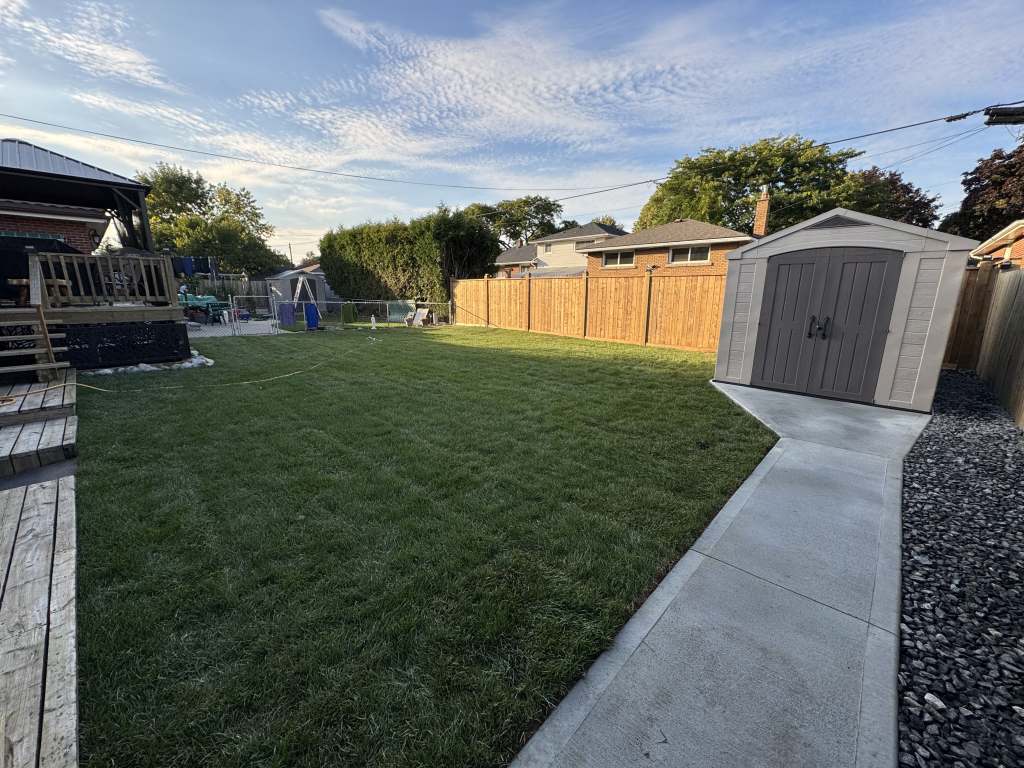
Sometimes the real fix is to reshape your own lawn so it falls away from the house and toward the swale, then re-sod it. It is the least visible fix and often the most effective. See yard grading in Hamilton.
Then we put the yard back: topsoil, sod, the beds and edges restored, so the only sign of the work is a dry lawn.
What about the neighbour?
A conversation helps more than a letter. Most people have no idea their downspout or new patio is sending water next door, and a downspout extension on their side costs them almost nothing. If the water is from their grading rather than a single source, you can ask, but you cannot require them to regrade. The fixes above all work without them, and that is how we design them. We never build anything that sends the water back; that only moves the argument.
Frequently asked questions
Water runs into my yard from my neighbour’s. What can you do?
Catch it at the line with a swale or a French drain, carry it to the street or a dry well, and regrade so it never reaches the house. All of it on your property.
Do you need to see the yard?
For drainage, usually yes, ideally after a rain. Where the water goes is the whole job, and photos rarely show it. We will come out and look before we quote.
Will the lawn be ruined?
Briefly. A swale or a drain is dug, filled and sodded over, and in a few weeks you cannot see where it went.
Dry out your yard this season
Call (905) 906-0671 or send the form on our contact page, with a photo taken in the rain if you can get one. We are quick to quote, quick to start, and we answer every call.