Restore or Replace? A 20 to 30 Year Old Paver Driveway
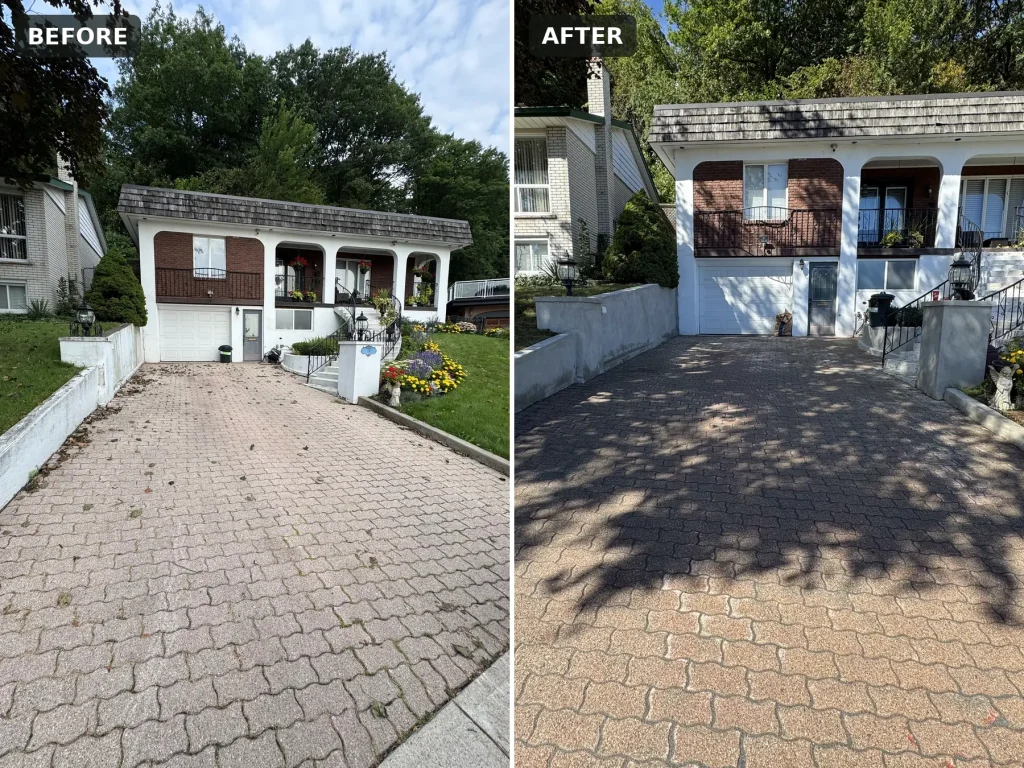
A paver driveway that is twenty to thirty years old can usually be restored rather than replaced, as long as the pavers themselves are sound and the base has only settled in places. Replace it when the stones are crumbling, when the whole surface has heaved and dropped, or when the base was never built properly in the first place.
That is the short version of how we decide. The long version, which is what we work through on a patio and interlock restoration in Hamilton, follows. We see a lot of these driveways in the Stoney Creek subdivisions built through the 1990s, where the original interlock is at the age when it either gets a second life or a replacement.
Why old paver driveways look worse than they are
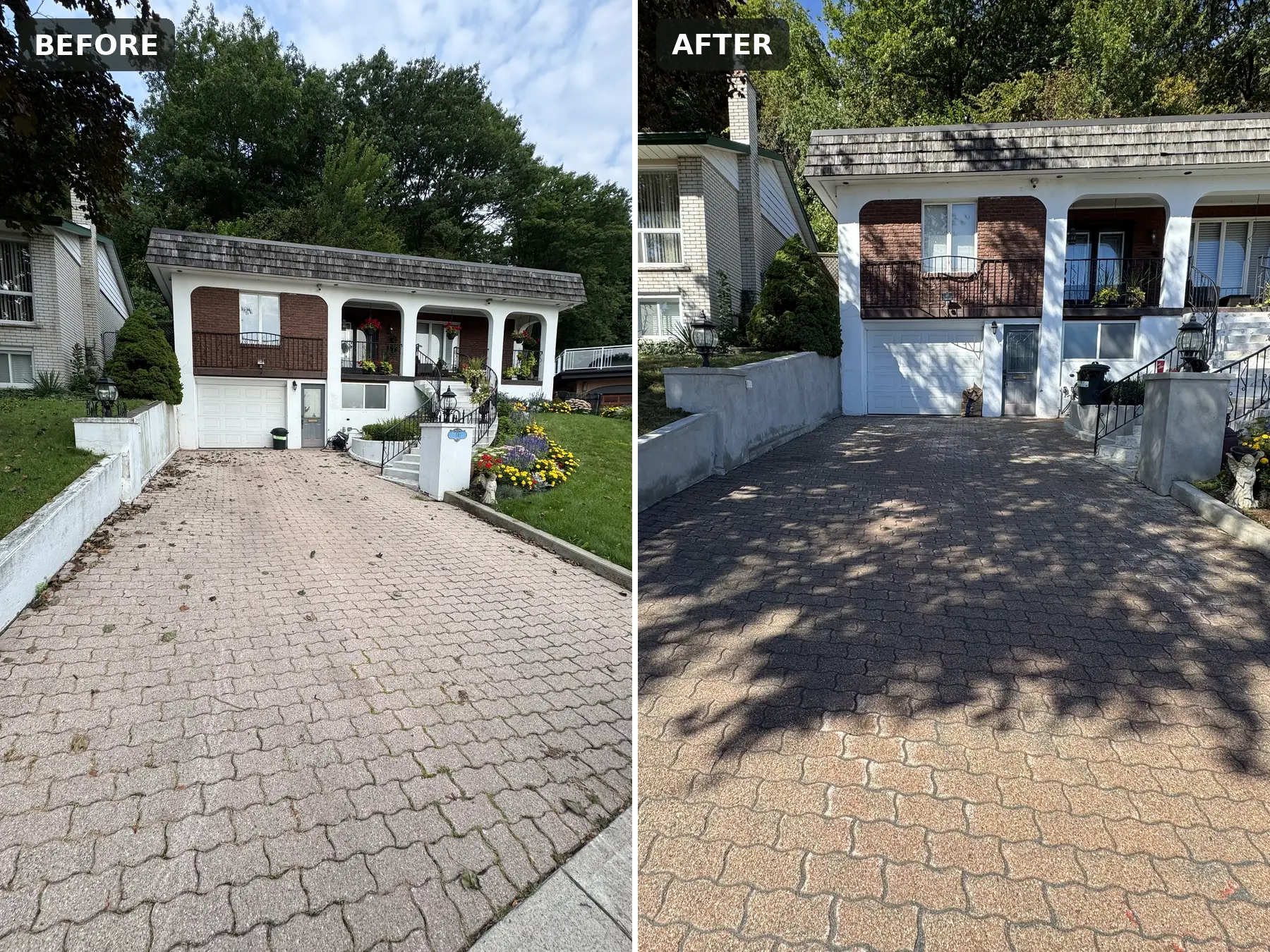
Most of what makes a twenty year old driveway look tired is on the surface or just under it. The joint sand has washed out, so weeds and ants have moved in. The colour has faded and the pavers are stained. The section at the garage has settled where cars stop, and the edge along the lawn has spread because the edge restraint gave up. None of that means the driveway is finished. All of it can be fixed without buying a single new paver.
The checks we make
Are the pavers sound?
Pick up a loose one and look at the edges and the back. Pavers from the 1990s were often thinner than today’s driveway rated stones, but a sound one is still solid, with crisp corners and no flaking. If the surface is scaling off in sheets, or corners are breaking away across the whole driveway, the stone has reached the end of its life and no amount of sand and sealer will change that.
Has it settled in places, or everywhere?
A dip at the garage apron, a low channel where the tires run, a sunken strip along a downspout: these are local base failures, and they are repaired by lifting that area, correcting and compacting the base, and resetting the same pavers. If the whole driveway rolls like a wave, or sits lower at the house than at the street, the base has failed across the full area, and the honest fix is to lift everything and rebuild the base. At that point you are paying for most of a new driveway anyway, and new pavers on a new base are the better value.
Which way does the water go?
A driveway that drains toward the garage or the house has a grading problem under it, not just a settling problem. Restoring the surface without fixing the fall puts the water back where it was. Sometimes that is a small regrade at the apron; sometimes it is the reason to rebuild.
Can the pavers still be matched?
If a few stones need replacing, we look for the same product or the closest current match. Where nothing matches, a new border in a contrasting stone around the restored field turns the mismatch into a design. Our guide to matching paver colours explains the trick.
What a restoration involves
- Lift the settled sections, dig out the soft base, bring in new granular, compact it in layers and reset the original pavers flush.
- Restore or replace the edge restraint so the field stops spreading.
- Pressure wash the whole driveway with a nozzle rather than a surface cleaner, so the joints are cleaned deep and the old sand, moss and weed roots come out.
- Sweep in premium polymeric sand, compact it with a rubber plate tamper, then a second application to fill and strengthen every joint.
- Seal, once everything is dry, in the finish you choose.
A driveway restored this way looks close to new and should go years before the joints need refreshing again. The 1990s driveways in Stoney Creek that were built on a proper base restore beautifully; the ones built on a few inches of sand usually need the rebuild.

What a replacement involves
The old pavers come up and the old base comes out. A new granular base goes in, deeper than a patio’s because it carries cars, compacted in layers and graded to fall toward the street. Then new driveway rated pavers from any brand you like, billed at cost, with edge restraint and polymeric sand. It costs more than a restoration, it takes a few days instead of one or two, and it resets the clock entirely. Our interlock page lists everything that goes under the new stones.
How to decide
- Sound pavers, local settling, water running the right way: restore.
- Sound pavers, settling everywhere or water running at the house: usually rebuild the base, and reuse the pavers if you love them.
- Crumbling pavers, whatever the base: replace.
We will tell you which of the three you have on the first visit, and if a restoration will do the job we will not sell you a replacement. Fixing what can be fixed is most of what our restoration work is.
Frequently asked questions
Can you fix just the low spots?
Yes, when the rest of the driveway is sound. Lifting and resetting the settled area is a normal repair, and the rest of the driveway is cleaned and re-sanded at the same time so it all matches.
How long does a restoration take?
One to two days for most driveways, plus a dry day before sealing. A full replacement takes a few days to about a week.
Will the weeds come back?
Polymeric sand, properly set and sealed, keeps most of them out for years. The ones that appear pull easily because they are rooted in a hair of sand, not in soil.
Not sure which yours is?
Send a few photos, including one of a loose paver and one of the worst spot, and call (905) 906-0671 or use the form on our contact page. Quick to quote, quick to start, and we answer every call.