Concrete
Hot Tub Pads and Shed Bases: Concrete, Pavers or Gravel?
Lumen Landscaping
For a hot tub, a reinforced concrete pad is the safest base: it stays level, it spreads a very heavy load evenly, and it gives the electrician something to work with. For a shed, concrete, pavers and compacted gravel can all work; the right one depends on how big the shed is, what its floor is made of and whether it will ever need to move.
We pour shed and hot tub pads across Hamilton and Burlington, built heavier than a walkway. Here is what each base does well and badly, what the electrical code and the cities add, and what we build. The rules below were checked on the City and authority sites on November 25, 2026.
What a hot tub or a shed asks of its base
Weight. Water weighs a kilogram a litre, so a tub that holds 1,500 litres carries a tonne and a half of water before the shell, the cover and the people. A shed carries less, but it puts it on a few lines and corners: the floor frame, the mower, a winter of stored things.
Level. A tub out of level shows at the waterline and loads its frame unevenly, and a shed out of level has doors that stick. The tub maker’s installation guide says what its base must be, so read it before you choose one.
Frost. A pad is not a frost footing. It sits on a compacted gravel base that drains, so there is little water under it to freeze and lift it. On the clay that holds water on Hamilton Mountain, that base is what keeps a pad flat through the winter.
Drainage. A pad should shed water gently away from the house and away from the neighbour. Think about the day the tub is emptied too: Hamilton’s guidance is to stop adding chemicals two weeks before, then let the water soak into your own yard, away from your house and your neighbour’s, or send it to the sanitary drain through a laundry tub or sink. The rule behind it is Hamilton’s Sewer Use By-law 14-090, which keeps pool and tub chemicals out of the City’s sewers and creeks.
Concrete, pavers and gravel compared
Concrete
- Good at: carrying a full hot tub without moving, staying level for years, and holding the bonding ring the electrical code can now ask for (more on that below).
- Less good at: being moved or added to later. A new slab never quite matches an old one, and a plain grey pad is plain, although stamped or exposed aggregate concrete can dress it up.
- Best for: hot tubs, swim spas and large or heavy sheds.
Pavers or flagstone
- Good at: looking like part of the patio. A tub or a gazebo can sit inside a larger paver area, and a paver can be lifted and reset if it settles.
- Less good at: heavy, concentrated loads on a thin base. Each paver moves a little on its own, so the base under a tub has to be deep, compacted and dead level, and the tub maker’s guide has to allow it. Ask the electrician how the tub will be bonded on pavers before you choose them.
- Best for: gazebos, pergolas and patio areas, and light sheds.

Screened gazebo on a flagstone pad
Compacted gravel
- Good at: draining freely and costing the least to build. A small kit shed with its own wooden floor frame often sits well on a level, compacted gravel bed with a border to hold it.
- Less good at: staying perfectly flat under point loads. Gravel ruts, shifts and settles where the weight is concentrated, and a tub maker’s guide may not accept it.
- Best for: small sheds, and as the base under concrete or pavers, where it does its best work unseen.
Sheds: size, permits and the swale
In Hamilton, a detached shed, garage or gazebo over 15 square metres needs a building permit when it goes with a detached, semi-detached or row house, and the permit drawings show the slab: its size, its depth and the strength of its concrete. Up to 15 square metres, one storey and with no plumbing, it needs none. Burlington’s list of projects that need no permit includes an accessory shed under 15 square metres, one storey and with no plumbing. In both cities the zoning still decides how close a shed can sit to the lot lines.
The spot matters as much as the base. Hamilton’s lot grading page lists sheds among the things that cause drainage problems, and it asks homeowners never to fill or block the swale, the shallow grassed channel along the property line that carries rain to the street. A pad dropped into a side yard swale ponds water for both neighbours. Our yard drainage page covers where the water should go.

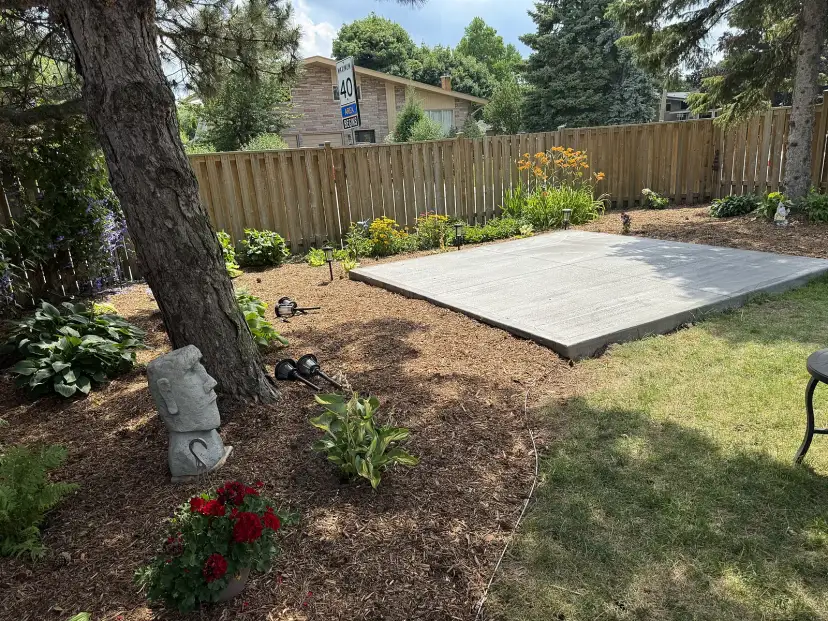
New concrete pad in a fenced side yard
Hot tubs: covers, fences and the electrician
The cover or a fence. Hamilton’s Swimming Pool Enclosure By-law 16-184 counts a hot tub that can hold water more than 0.6 m deep as a pool. It needs a rigid cover able to carry 90 kg, or one meeting the ASTM standard for hot tubs, fastened and locked whenever the tub is not in use; a tub without one needs an enclosure that meets the by-law. Hamilton also requires a building permit for a deck used with a swimming pool, so if the tub will be set into a deck, ask the Building Division whether that applies. In Burlington, a hot tub needs a permit before it is installed: one under 8 square metres has its own hot tub permit, and no water goes in until the fencing or the lockable lid has been inspected and approved by a by-law officer.
The wiring. The Electrical Safety Authority (ESA) says pool and hot tub installations usually need both a building permit and an electrical permit, and that the electrical permit is often overlooked. Anyone you hire for electrical work must be a Licensed Electrical Contractor, who can file the permit with ESA for you. We do not do the electrical; we leave the conduit path where your electrician needs it.
The bonding ring. Since the 2024 Ontario Electrical Safety Code took effect, ESA says a hot tub may need to be bonded to a copper ring of No. 6 AWG bare wire embedded in a conductive surface such as the concrete slab under it, and work filed with ESA from October 1, 2025 has to meet the revised rule. A ring embedded in a slab goes in before the pour, so talk to the electrician before the pad is booked.
Overhead wires. Keep the tub out from under them. ESA notes that the local utility sets the clearance from its lines.

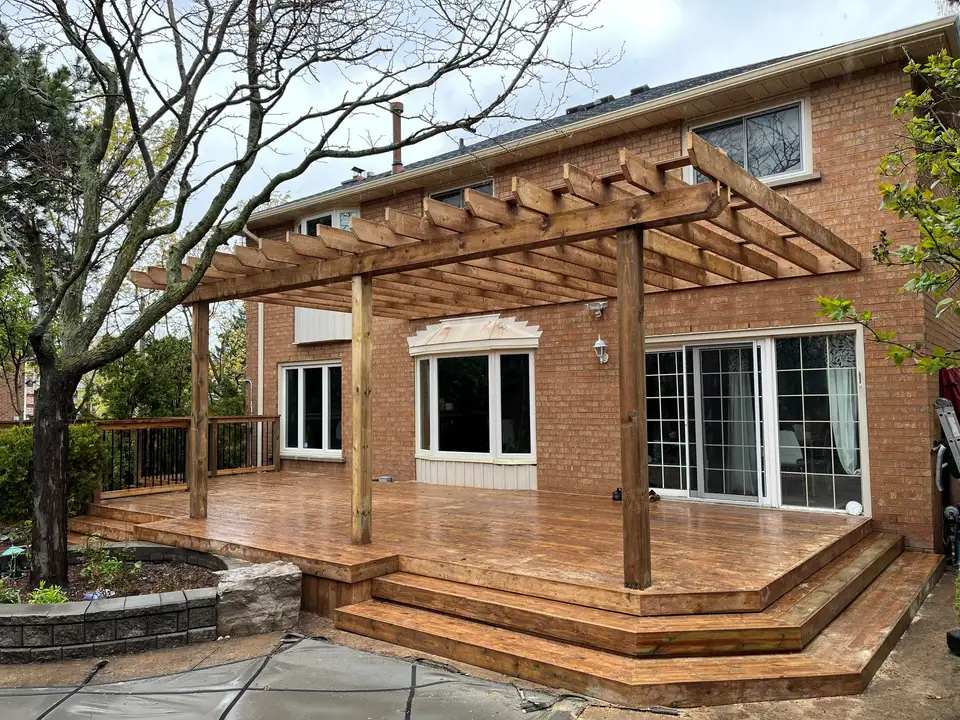
Wood deck with privacy screens and a pavilion
What we build
- Concrete pads for hot tubs and sheds: We excavate and dispose of the soil, install 5 inches of compacted aggregate base, lay wire mesh reinforcement and pour 5 inches of 32 MPa concrete with a brush finish, then cut stress joints, strip the forms and clean the concrete. That is heavier than a walkway on purpose.
- Sized for your tub: Send us the model or its measurements and the pad is built to suit, with the conduit path left where the electrician wants it. A new pad has to cure before a filled tub sits on it, and we tell you the date it is ready.
- Interlock and flagstone pads: Under a gazebo, a pergola or a seating area, usually a little bigger than the structure’s footprint, as part of an interlock patio or on its own.
- The shed itself: We also build custom sheds on site, on the same pad; see pergolas, gazebos and sheds.
Concrete and stone are billed at what they cost us, with no markup, and the written quote lists the base, the mesh and the thickness. A pad is a small job, and a welcome one.
Frequently asked questions
How thick should a hot tub pad be?
Ours are 5 inches of compacted aggregate base under 5 inches of 32 MPa concrete with wire mesh. Check the tub maker’s installation guide too, since it sets what that tub needs.
Can a hot tub sit on pavers?
It can, on a deep, compacted, perfectly level base, if the tub maker allows it. Ask the electrician how the tub will be bonded on pavers before you decide; on a concrete pad the answer is simpler. Our concrete page covers the finishes if plain grey is not the look you want.
Do I need a permit for a hot tub or a shed?
Possibly for both. A hot tub needs an ESA electrical permit, a locking cover or an enclosure under Hamilton’s by-law, and a permit before it goes in under Burlington’s. A shed needs a building permit over 15 square metres in Hamilton, and at 15 square metres or more in Burlington. We tell you before we quote what applies; our permits guide lists the sources.
Where these rules come from
Checked November 25, 2026:
- City of Hamilton: Building Permit Application Requirements, Residential Accessory Buildings, Porches and Decks, Swimming Pool Enclosure By-law 16-184, Lot Grading and Drainage and Emptying Pools and Hot Tubs
- City of Burlington: Building Permits and Pool Permits
- Electrical Safety Authority: Resources for Municipalities, the May 2025 notice on pool and hot tub bonding and Grounded in Ontario: Pools and Hot Tubs