
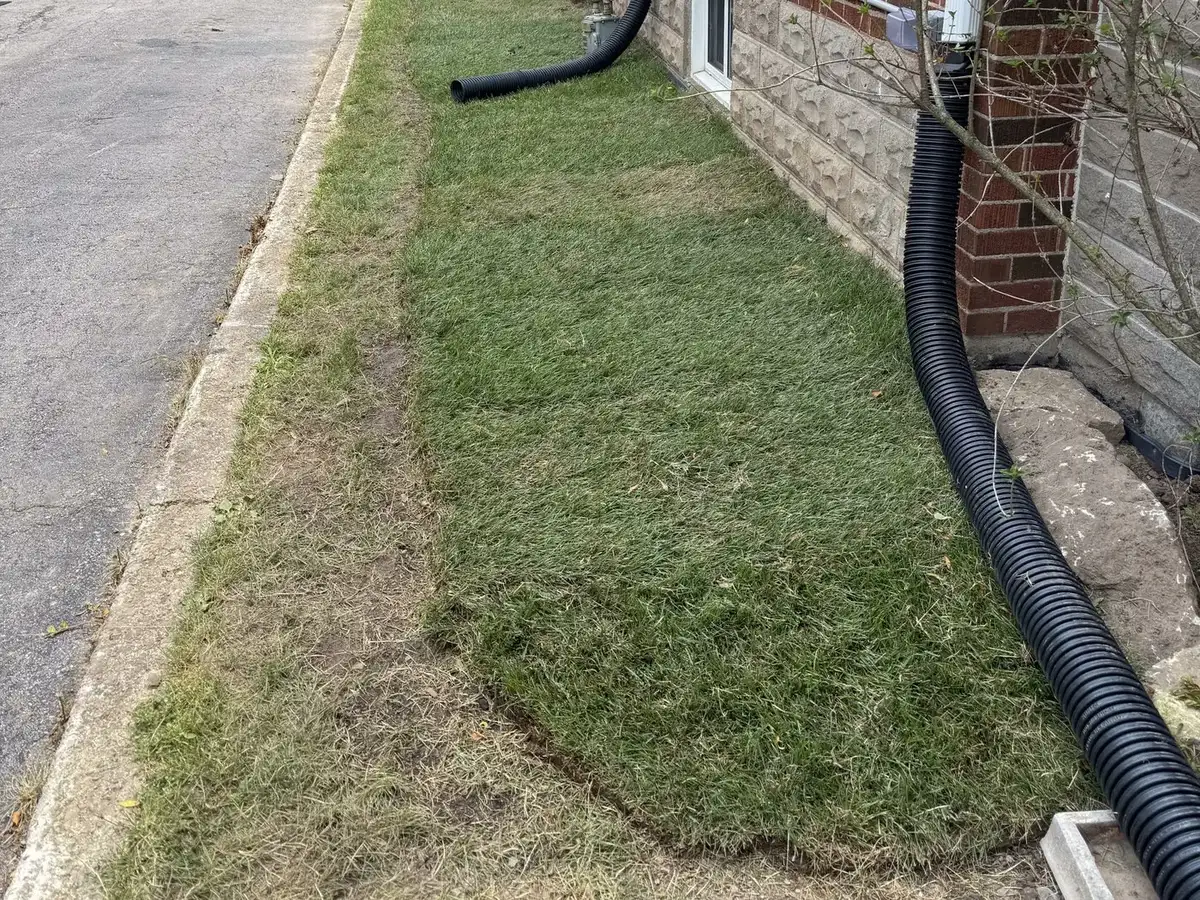
French Drains and Yard Weeping Tile in Hamilton
A French drain is a buried trench of clear stone and perforated pipe that collects water from a wet strip of yard and carries it to an outlet.
Materials at cost, no markup.
Call (905) 906-0671 or get a free written quoteQuick to quote, quick to start, we answer every call.Start dates are booked in the order quotes are accepted.
- Materials at cost no markup
- Free written quotes
- Fully insured
- 1-year craftsmanship warranty
- Hamilton owned and operated
Get your fast, free quote
We'll contact you quickly, usually within the hour. Planning for spring? We quote all winter.
We build them for soggy side yards, the foot of a slope and water arriving from next door, along with yard weeping tile and downspout lines run underground. Lumen Landscaping builds French drains across Hamilton: call (905) 906-0671 or send the form for a free written quote.
Serving Hamilton, Ancaster and Burlington, from Mississauga to St. Catharines and inland to Guelph, Cambridge and Brantford.
French drains
What a French drain is, and when a yard needs one
A French drain is a trench lined with filter fabric and filled with clear stone, with a perforated pipe laid in it on a steady fall. Water soaks into the stone, runs into the pipe and travels along it to an outlet where it can leave. It is the fix for a strip of yard that stays wet after every rain and has no lower ground to shed the water on the surface.
In Hamilton that strip is usually sitting on clay. On the Mountain, in Binbrook and across the clay plain south of the escarpment, water cannot soak down, so it has to be carried sideways to somewhere it can leave. Below the brow, in Stoney Creek and Ancaster, the water comes down the hill as well, and it stops at the first flat yard it reaches. Our yard drainage page covers every fix we use. This page is about the buried ones: French drains, weeping tile along walls and the edges of patios, and downspout lines run underground.
Call (905) 906-0671 or send the form and tell us where the water sits after a rain and where you think it comes from. Email a photo taken after a storm to info@lumenlandscaping.ca if you have one, and we can often tell you whether a French drain is the right fix before anyone digs.
Featured project
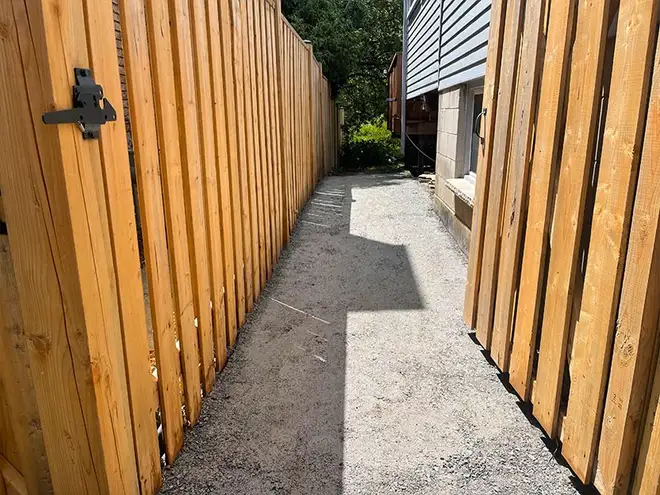
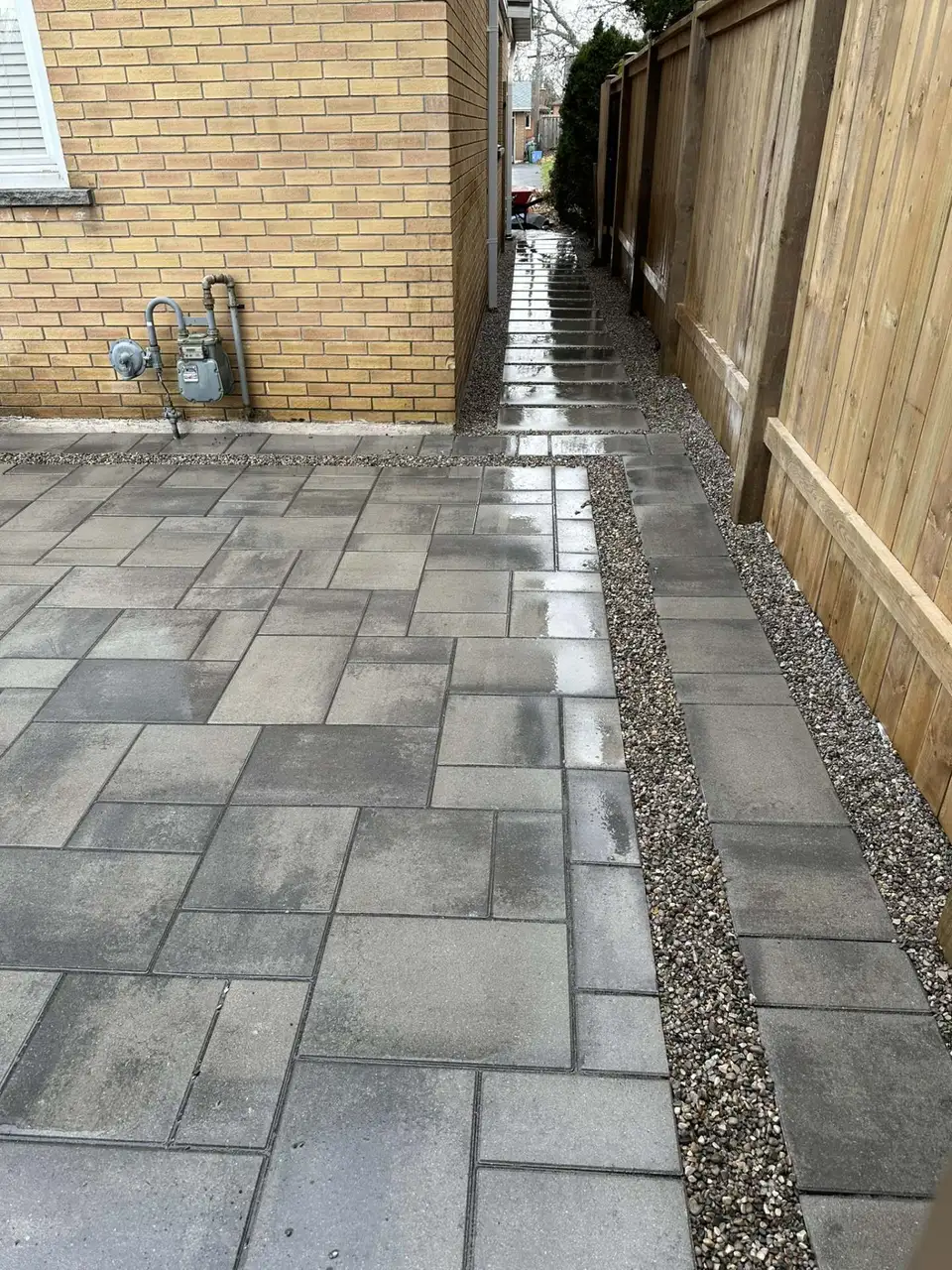
Side yard graded in compacted screenings See all projectsOur Work
Finished yards from our crew
-
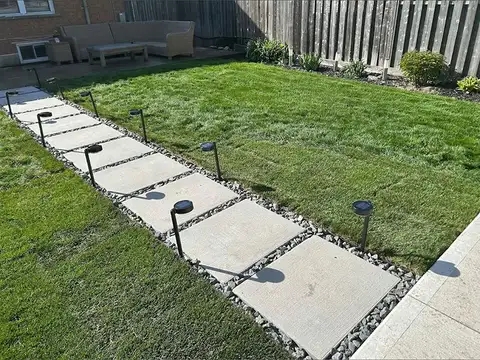
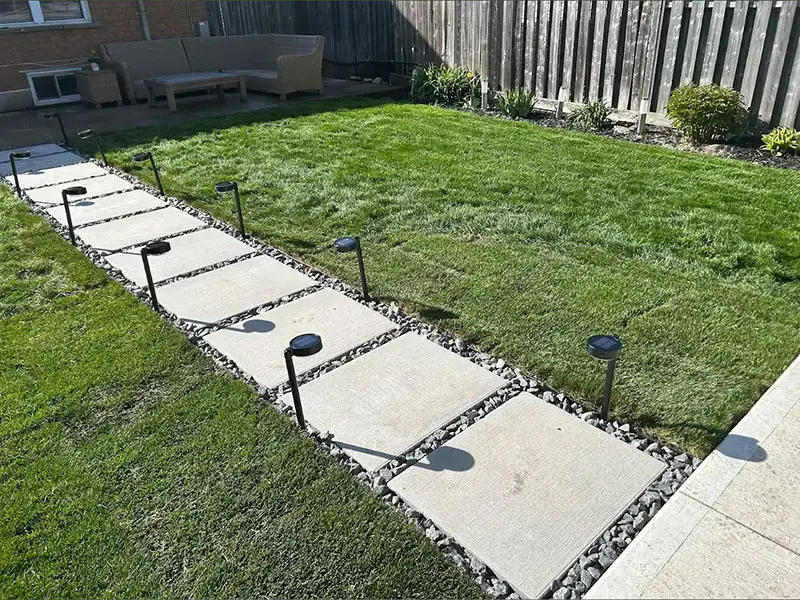
Slab stepping stone walkway with path lights -
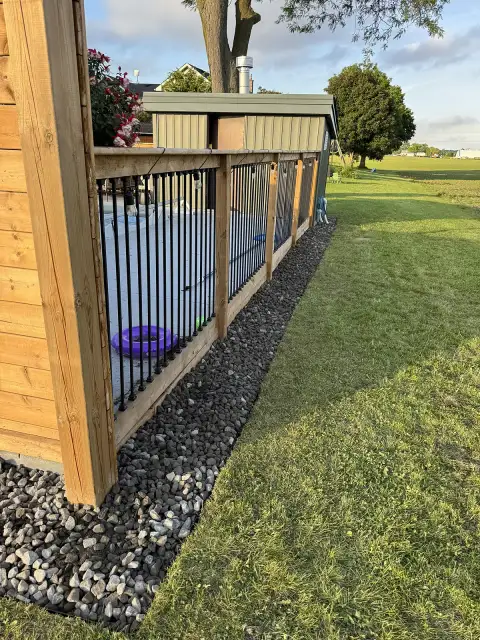
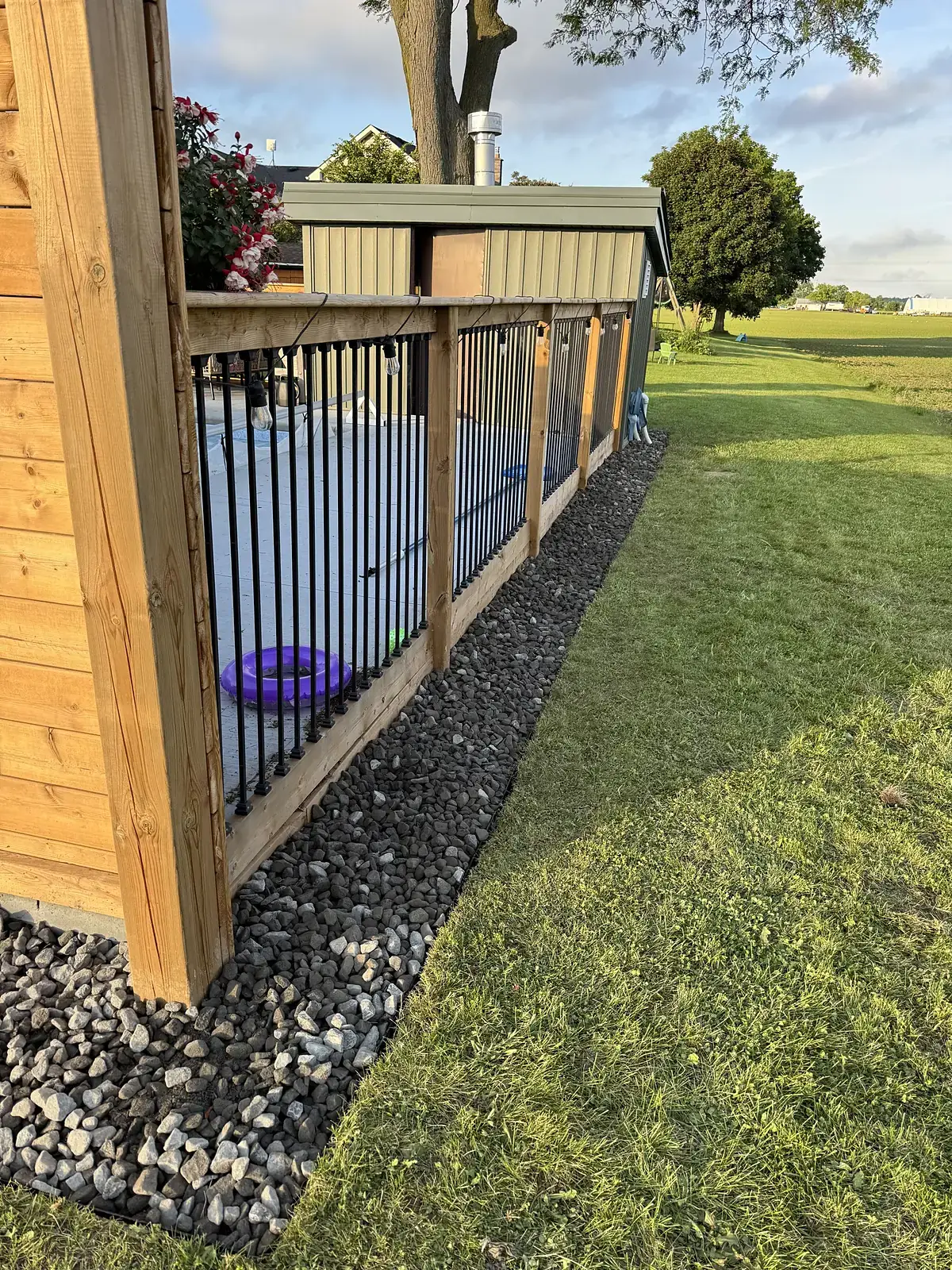
Wood and metal picket fence with a river rock border -
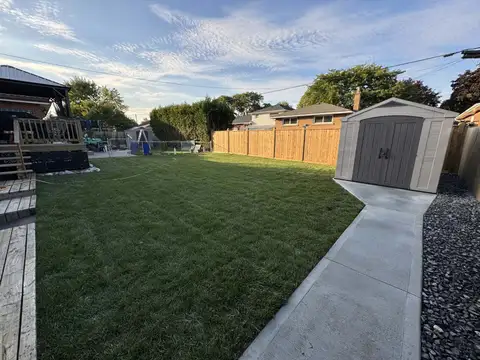
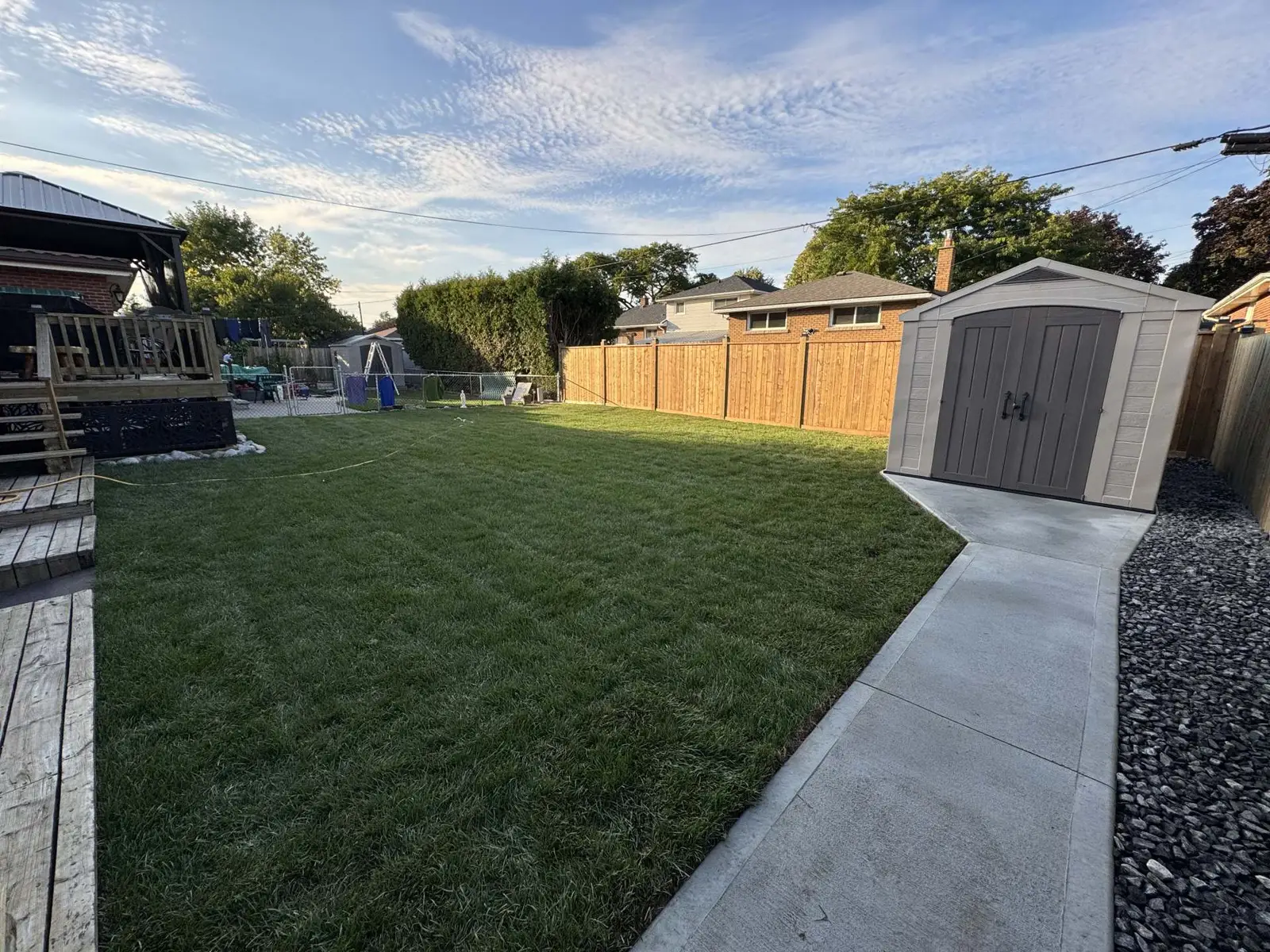
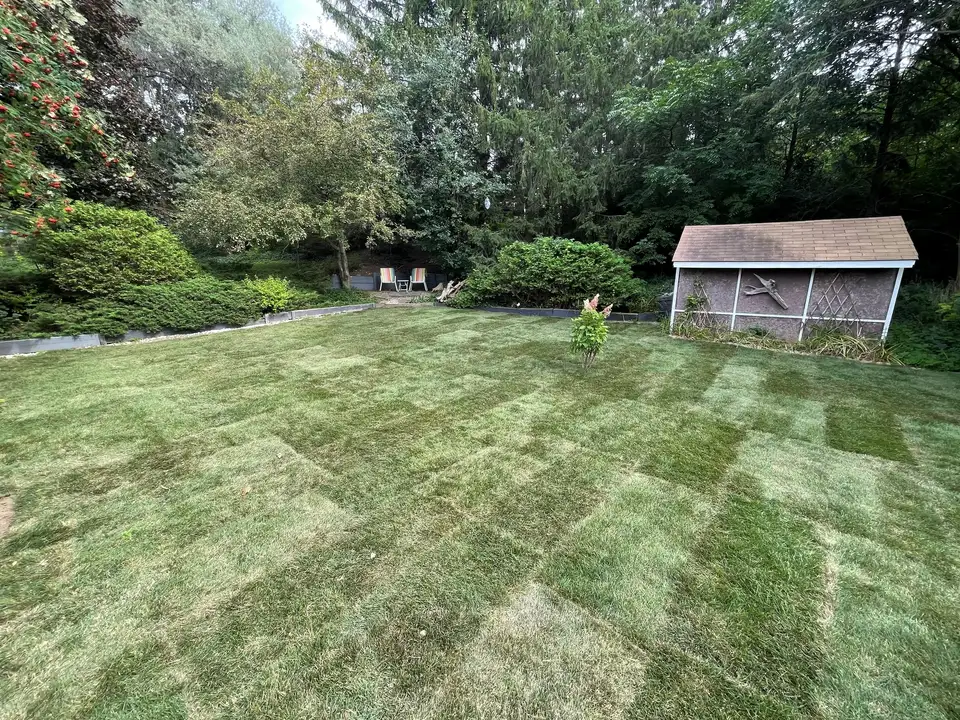
New sod and concrete walkway, Hamilton Mountain, September 2025
When a French drain is the right fix
Water that sits for a day after rain is arriving faster than the ground can take it. A French drain is one answer, and these are the yards where it is the right one.
When it is not the answer. If the water sits in a broad low area or against the house, the ground is shaped wrong, and regrading fixes it with nothing buried to maintain. If the water arrives on the surface along a lot line and the lot has fall, a shallow grassed swale carries it in the open. We tell you which your yard needs, and many yards need a little of each.
-
“The team did an excellent job re-sodding our backyard.
They were professional, careful working around our pool, and the finished result looks fantastic.”
Sabah Google review
-
“I recently had Lumen remove the surface of our weed-infested lawn and replace it with fresh sod on the larger of two areas, and river rock on the smaller area.
It was a pleasure dealing with Jeff at Lumen.”
Chris L. Google review
-
“Excellent experience with Lumen Landscaping.
Efficient, knowledgeable, hardworking, and my lawn looks fantastic. Highly recommend! I had Lumen landscape a second project one year later. Same terrific experience.”
Kellie-Lyn C. Google review
Downspouts and eavestroughs: getting roof water away
The water off the whole roof comes down a few downspouts, and one emptying beside the foundation feeds every wet problem in the yard. Moving that water is often the first fix and the simplest.
Above ground. An extension to daylight, well away from the house. It works, but it crosses the lawn, the mower catches it, and it ends up back on the walk.
Underground. A solid pipe from the bottom of the downspout, buried under the lawn or a walkway, carrying the roof water to a pop-up emitter in the lawn, a swale, a dry well where the soil drains, or a French drain that carries it off. The pipe is solid, not perforated, so the roof water travels instead of leaking out beside the foundation on its way. Nothing shows above ground except a small cap in the grass, and the line is laid on a steady fall so it empties between storms. Read downspouts, eavestroughs and sinking driveways.
Pop-up emitter or French drain. An emitter is the end of a downspout line: the water pushes its cap up and spreads onto the lawn. It releases roof water; it does not collect water from the ground. That is the French drain’s job, and on a wet lot the two often work together.
Hamilton’s downspout rules. Hamilton’s sewer and drain by-law now includes a section on the required disconnection of downspouts in parts of the city, to keep roof water out of the sewers. The City’s own advice for a disconnected downspout is water that runs onto grass or a garden, away from the foundation, off the walkway and the driveway and not onto the neighbour’s lot, with the ground sloping away from the house for at least a metre. We build every downspout line to that standard. The City’s Protective Plumbing Program offers eligible homeowners a grant toward disconnecting downspouts; call the City at 905-546-2489 to see if your home qualifies. Yard drainage work such as a French drain is not on that program’s list. The downspout, grading and fill rules sit beside the others in our guide to landscaping permits in Hamilton and Burlington.
Why Hamilton homeowners choose Lumen for drainage
We do the grading, the drains and the lawn, so one crew fixes the wet corner from the first trench to the new sod. You get a fast reply, a written quote that says where the water will go and why, and the same people from the first visit to the cleanup.
- Materials at cost, no markup You pay what the pipe, stone, fabric and sod cost us; the contractor discount is passed straight to you.
- 1-year craftsmanship warranty Our craftsmanship is warranted for one year.
- Fully insured Liability coverage on every job, so your home is protected while we work.
- Over 40 five-star Google reviews Local homeowners rate us 5.0 on Google.
Yard weeping tile, and what we leave to a waterproofing contractor
Weeping tile is the same perforated pipe in clear stone and fabric, laid at the base of something: behind a retaining wall, along the edge of a patio or a walkway, or across the foot of a slope. Every retaining wall we build has it behind the wall, so water never builds up and pushes.
What we do not do. Weeping tile at the footing of your house, interior weeping tile, sump pumps and basement waterproofing are a foundation or waterproofing contractor’s job, and we say so. If the basement already leaks, call one of them first. If water is reaching the foundation from the yard, the grading and the drains outside are ours, and the two kinds of work go together. Read weeping tile for homeowners.
Step by step
How we build a French drain
Every French drain we build follows the same order, because a drain that skips a step fills with silt or holds water instead of moving it.
-
The outlet, first
Before a trench is marked, we decide where the water will leave: daylight at a lower part of the lot, a swale, a yard catch basin, or a dry well where the soil drains. The outlet never empties onto a neighbour, a walkway or a driveway.
-
Locates
The buried gas, hydro and telecom lines are marked through Ontario Dig Authority (formerly Ontario One Call) before any trench is dug. The locate is free and takes about five business days.
-
The trench and the fall
Dug from the wet area to the outlet with a steady fall the whole way, usually at least one per cent, about an inch for every eight feet, and more where the yard allows.
-
Filter fabric
The trench is lined with filter fabric, so the clay and silt around it stay out of the stone. This is what keeps a drain working year after year.
-
Clear stone and perforated pipe
A bed of clear stone, the perforated pipe laid on it to the fall, more clear stone around and over the pipe, and the fabric folded over the top.
-
Backfill and the finish
Soil over the fabric, compacted so it does not settle into a dip, and the surface finished in new sod, a garden bed or a river rock strip.
-
The first storm
We ask you to watch the first heavy rain and call us if anything still sits.
Planning
Before we dig: the City, the neighbour and the price
Lot grading is yours to keep. When a Hamilton subdivision is built, the City approves a grading plan for every lot, and the homeowner is responsible for keeping it. A French drain works with that plan: it never fills a swale or covers a rear yard catch basin. The City’s Lot Grading staff can be reached at 905-546-2489 if you want the approved plan for your lot.
The neighbour. Water from your yard cannot be sent onto a neighbour’s. An outlet near the lot line is placed so the water leaves toward the street or a swale, never over the line. Read when the water comes from next door.
Routine landscaping. Hamilton’s site alteration by-law lets routine landscaping go ahead when no more than 15 cm of fill is added anywhere, drainage onto neighbours does not change and no swale is altered or blocked. A French drain built the way this page describes stays inside those limits, and we tell you plainly if a job would not.
Not included. Anything inside the foundation, and a connection to a municipal storm sewer, which needs the City’s approval.
What affects the price.
- How far the water has to travel to reach an outlet
- How deep the trench must go to keep its fall
- Pipe, stone and fabric, billed at cost
- How many downspouts are tied in
- The surface you want back: sod, a bed or river rock
- Access for a mini excavator, or hand digging behind a narrow gate
The season. Spring to late fall, while the ground is not frozen. Spring is when the problem shows, and fall is often the easiest time to dig.
Related
Start from what you are seeing
The symptom pages: water pooling in the yard after rain, water draining toward the house, runoff from the neighbour’s yard, a muddy side yard and clay soil. Related: yard drainage, grading, retaining walls and landscaping a new build.
How it works
Getting started is easy
-
Call or send the form
Tell us what you have in mind. We'll contact you quickly, usually within the hour.
-
Get your free quote
We look at your project and send you a clear, written quote quickly.
-
We build it
We start quickly and back our craftsmanship with a 1-year warranty.
Service Areas
Where we build French drains
Hamilton is home: Hamilton, Ancaster, Dundas, Stoney Creek, Waterdown, Mount Hope, Binbrook and Glanbrook and Flamborough. Run-off from the escarpment is the usual story below the brow in Stoney Creek and Ancaster, and clay is the story on the Mountain and in Binbrook. We also work in Burlington, Grimsby, Oakville, Mississauga and Cambridge, and as far as St. Catharines and Brantford. See all our service areas.
FAQs
French drain questions
Does a French drain need an outlet?
Always. A French drain collects water, and the outlet is where that water leaves: daylight at a lower part of the lot, a swale, a yard catch basin, or a dry well where the soil drains. On clay a dry well fills and stays full, so on most Hamilton lots the water is carried to the surface somewhere lower or into a catch basin. Without an outlet the trench simply fills and holds the water, so we find the outlet before we mark the trench.
How much fall does a French drain need?
A steady fall for its whole length, usually at least one per cent, which is about an inch of drop for every eight feet of pipe, and more where the yard allows. More fall is fine. What fails is a low spot partway along where water sits, so we check the fall as the pipe goes in, not only at the two ends.
What is the difference between a French drain and a trench drain?
A trench drain, also called a channel drain, is a narrow channel with a grate on top, set level with a driveway or a patio to catch water running across the hard surface. A French drain is buried under the lawn or a bed and catches water soaking through the ground. For water running across pavement the answer is usually the slope of the surface or a catch basin at the low spot; for a strip of lawn that stays wet, it is a French drain. We tell you which once we have seen where the water comes from.
Is drain tile the same thing as a French drain?
Not quite. Drain tile and weeping tile are two names for the same perforated pipe. A French drain is the whole trench built around that pipe: the filter fabric, the clear stone and the pipe laid on a fall to an outlet. So a French drain has drain tile in it, and weeping tile laid along the base of a wall is a French drain built along that wall.
Should I use a pop-up emitter or a French drain?
They do different jobs. A pop-up emitter is the end of a solid pipe from a downspout: roof water pushes its cap up, spreads onto the lawn, and the cap drops back when the flow stops. A French drain collects water that is already in the ground. Many yards use both: the downspouts run underground to an emitter in an open, lower part of the lawn, and a French drain takes care of the strip that stays wet. On clay that is already soaked, an emitter has nowhere to send the water, so we carry that line to a swale or a drain instead.
Does a French drain freeze in winter?
The ground over it freezes, but a drain laid on a steady fall empties itself after each rain or thaw, so there is little water left in the pipe to freeze. The part to watch is the outlet: one that ends in a low hollow can ice over and back up. We end every outlet where the water can run away from it, and we keep the stone and pipe deep enough under the surface to stay out of the way of the lawn and the snow.
How long does a French drain last?
A long time, when it is built with filter fabric, clear stone and a steady fall. Silt is what clogs a drain, and the fabric keeps the clay and silt around the trench out of the stone. The drains that fail early were built without fabric, laid flat, or ended in an outlet that was later buried or blocked. Keep the outlet clear and the drain keeps working.
What does a French drain cost?
It depends on how far the water has to travel to an outlet, how deep the trench has to go to keep its fall, how many downspouts tie in, how a machine gets into the yard, and the surface you want back over it. Pipe, stone and fabric are billed at what they cost us, with no markup, and the written quote is free.
Get Free Quote
Get a Free French Drain Quote
Tell us where the water sits and where it seems to come from, and email a photo taken after a rain to info@lumenlandscaping.ca if you have one. We will find the outlet first, come out when the yard needs a look, and get back to you fast with a free written quote.
Contact us today!
- Materials at cost no markup
- Free written quotes
- Fully insured
- 1-year craftsmanship warranty
- Hamilton owned and operated